Sunday, April 5, 2026

Can You Say "Schjerfbeck"?

"Self-Portrait, 1912"
Oil on Canvas, 43.5 x 42 cm
Helene schjerfbeck, 1912


Though she is relatively unknown in the United States, I have admired the work of Helene Schjerfbeck for years.  Imagine my excitement when I learned that the Metropolitan Museum was mounting the first ever retrospective in the US devoted to her work. Cause for a trip to New York!  And the exhibit did not disappoint. It's one thing to look at reproductions in a book, but quite another to see the paintings in person. 


"Still-life in Green"
Oil on Canvas, 33.5 x 50 cm.
Helene Schjerfbeck, 1930

The difference is especially notable with a painter like Schjerfbeck, whose work involves a lot of textural manipulation.  Schjerfbeck chose different textures of canvas for different effects. She did a lot of back-and-forth work, putting down paint and then scraping it off.  The result is a painting that is "alive", and that shows the hand of the artist and the process of developing the painting.  In many cases (see above) the raw canvas is left showing through and is incorporated into the motif.

"Red Apples"
Oil on Canvas, 40.5 x 40.5 cm
Helene Schjerfbeck, 1915


Perhaps my favorite painting was the one just below, "Fragment".  As the wall copy at the Met notes, Schjerfbeck would have seen Renaissance frescoes in Italy a few years before making this painting, and the abraded surface calls to mind the deterioration of ancient frescoes wrought by time.  Besides the surface quality, I love the tenderness of this image, so vulnerable. In person, it practically glows.


"Fragment"
Oil on Canvas, 31.5 x 34 cm
Helene Schjerfbeck, 1904


It was a treat to see Schjerfbeck's minimalism, and elimination of details. She said so much with so little. Schjerfbeck wrote to a friend, "Let us avoid executing so precisely and exactly that our work closes the way instead of opening it. Let us IMPLY."  A woman after my own heart.

"At Home (Mother Sewing)"
Oil on Canvas, 86.5 x 62.3 cm
Helene Schjerfbeck, 1903

The exhibit at the Met closed on April 5, 2026, but you can still get the catalog on Amazon here.  Well worth a look!  I like the catalog from the Met exhibit, but even better (in my opinion) is the catalog from the Schjerfbeck exhibit at the Royal Academy of Arts in London in 2019.  It focuses more on an examination of her process, and it's available on Amazon also.  Happy reading!


Friday, February 27, 2026

Living Vuillard


If you've been reading the blog for a while, you know that I am a lover of Edouard Vuillard and the Nabis.  So you may not be surprised to learn that I had a gestalt "Vuillard moment" this week.


I was working on the needlework project pictured above, and as I bent over my yarn and needle, I felt just like a figure in a Vuillard painting.  Vuillard's mother was a seamstress (a corset maker, to be exact), and images of women sewing appear often in his work. In fact, I have studied some of his paintings by doing transcriptions of them (one shown below).  


"Woman in a Striped Dress", Edouard Vuillard, 1895


And then another connection dawned:  the needlepoint canvas I was working on was oddly reminiscent of the first Vuillard painting I ever saw, at the National Gallery in Washington, D.C., "Woman in a Striped Dress".  Do you see the connection??  I guess all roads lead to Vuillard.


And in current events, the Skarstedt Gallery in New York is mounting a Vuillard exhibit next month.  The focus will be on his early interiors--some of my favorites. I hope to see the exhibit and garner new inspiration.  Stay tuned!


Wednesday, January 28, 2026

Iconic Gardens

"Tuileries Icons"
12 x 16 inches, Oil on Cradled Panel
(c) Lesley Powell
(SOLD)

I'm illustrating this post with a new series of paintings inspired by the grand public gardens of Paris.  Two of my very favorite spots in Paris are the Luxembourg Gardens and the Tuileries Gardens. They have it all:  flowers, green lawns, sculptures, fountains, and wonderful people-watching.  Here are some fun facts about these gardens. 


"Together"
12 x 9 inches, Oil on Cradled Panel
(c) Lesley Powell

The Jardin des Tuileries take their name from tile making factories that once stood on that spot.  The French word for tile is "tuile".  "Tuileries" are workshops that made roof tiles, which occupied the area during the Middle Ages.  Catherine de Médici kept the name when she built her palace there in 1564--and so it carries on today.


"Two Pairs", 12 x 9 inches, (c) Lesley Powell


Both the Tuileries and Luxembourg Gardens have a symmetry  defined by broad walkways.  The walkways are not your ordinary sand or gravel.  Non!  They are made with a traditional French mixture called "stabilisé".  It's a combination of crushed gravel, sand and whitewash.  Stabilisé was developed in the 1600's by the great garden designer André Le Nôtre.  It is beautiful to look at, and has a pleasing crunch under foot, but boy can it be dusty. 


"Three's a Crowd"
12 x 16 inches, Oil on Cradled Panel
(c) Lesley Powell
(SOLD)

I especially love the green metal chairs that grace these gardens. The Sénat chairs are unique to the Luxembourg Gardens, and cannot be purchased by the public.  But a close interpretation was introduced in 2002, and is widely available.  It's made of aluminum, so is much lighter, and called the "Luxembourg" chair.  I wish I had a spot at home to put a few of these--a way to bring Paris home.  These paintings are another way.


"Adjoining", 9 x 12 inches, Oil on Linen Panel, (c) Lesley Powell


Final Fun Fact:  You can adopt a bench in the Tuileries--for a mere 5,000 euros!  Check it out here.

And to conclude:  One reason I love these places is that they are virtually unchanged from a hundred years ago.  Look at these paintings by John Singer Sargent and Felix Vallotton, and you will see the same features we enjoy today. The mounted urns and sculptures and balustrades have stood the test of time.  Enjoy!


John Singer Sargent, "In the Luxembourg Gardens", 1879

Felix Vallatton, 1895


Monday, January 5, 2026

Thought for the New Year


Some things bear repeating, so please indulge me with this post, much of which I wrote a few years back.  The New Year is the time when everybody focuses on goals and improvement. It's easy to make resolutions to improve our skills, or our productivity.  But every serious painter knows the hard truth: there are many stumbles on the path to improvement, and you must be willing to fall, and then pick yourself back up, and start over. Progress can be sporadic (and that's an understatement). Many hours must be put in. Courage and perseverance are key.


I reflected on this truth while reading an article that discussed how babies learn to walk. Toddlers learning to walk are so determined that they travel the length of about eight football fields in ONE HOUR. During that hour, they fall an average of 30 times. It takes 2.6 million steps for them to become proficient at walking. As the article notes, a failure rate like this would be deeply discouraging (the article even said "catastrophic") for an adult trying to learn a new skill. 

Toddlers persevere in learning to walk because faster, hands-free mobility is thrilling to them.  Adults persevere in our endeavors because mastery of a new skill is nirvana


Toddlers also teach us that learning is not linear.  They often start to walk, and then revert to crawling for a while. Their progress is U-shaped.  In other words, when learning a new skill, we often get worse before we get better.

Another important lesson is that infants learn best "when operating near the limits of their current skill level."  The takeaway for the rest of us is clear:  Always be "at the edge of what you can't currently do."  


 "Stacked"
18 x 12, Oil on Cradled Panel


I've written about the creative process before, and the example of toddlers learning to walk reinforces some of the notions I explored then. It's a nice concrete example to keep in mind as we start the New Year.  Yes, it's frustrating to be at the edge of what you can't currently do--but oh, the rewards are great when you can push that boundary a little bit further!  Wishing you all a happy and healthy 2026!


Monday, July 7, 2025

Paris Petites


The month of May--what a marvelous month to be in Paris!  I tried to soak up every bit of the French capital that I could.  In addition to croissants and delicious stinky cheeses and visits to museums, I spent hours out and about with my easel, painting.  Painting on location is a way to really SEE.  It forces you to slow down and take in all the aspects of your surroundings. 


"Seine Reflections", 9.5 x 7.5 inches, Oil on Canvas Panel


One of my favorite places to paint in Paris is along the quais of the Seine.  The river is always a different color, depending on the sky, the sun, the winds, and the time of day.  So no painting of the same spot is ever the same!  And did I mention the beautiful bridges, and the reflections they make in the water?


"Louvre, Morning Effect", 6.25 x 9.5 inches, Oil on Canvas Panel


I also love to paint in the gardens.  It's hard to say which is my favorite--the Luxembourg Gardens or the Tuileries.  Both have wide passages of white-ish sandy gravel, creating shapes and angles that are very appealing.  Both are punctuated by monuments of quintessentially French architecture (the Sénat building at Luxembourg, or the Louvre at the Tuileries).  So much to savor!


""Pont Marie, Soft Light", 8 x8 inches, Oil on Linen, mounted on panel

I'm illustrating this post with several paintings I did on location in my favorite spots.  These and more are available at the time of this post (July 7, 2025) on my website, here.  Take a look, and enjoy this virtual trip to Paris!


Tuesday, June 3, 2025

In Hopper's Footsteps


"Stairway at 48 rue de Lille, Paris, 1906"
Edward Hopper


 Years ago, I was captivated by an exhibit at the Mint Museum in Charlotte, "Hopper in Paris".  We think of Hopper as a quintessentially American painter, but he spent a significant amount of time in Paris between 1906 and 1910.  And that time yielded over one hundred drawings and paintings.  During his early Parisian stays, Hopper lived at 48 rue de Lille, in the 7th arrondissement.  His quarters adjoined the Evangelical Baptist Church (which had sponsored his visit).  Here's what it looks like now:


And guess what?  I was there last month!  The ground floor is now a space dedicated to art exhibits, and my friend Marie Sand had an opening there to which I was invited.  Imagine my excitement when she showed me the courtyard--the very one that Hopper had painted. Here's the courtyard as painted by Hopper, and how it appears now:


I poked around the building a little bit, and discovered some humble stairways that were very reminiscent of the one Hopper painted (top image).  Perhaps not the very stairs that were the subject of Hopper's painting, but close enough to give me goosebumps.  It's a thrill to stand in the footsteps of a great painter from the past, and to get a glimpse into his life and his painting process.  I learned from standing in Hopper's shoes that the most humble places can be the impetus for memorable paintings.   


I'm closing with another Hopper painting of his courtyard at rue de Lille, from a higher vantage point.  I can see in these early paintings the themes that would come to define Hopper:  interior spaces without human activity, and the architecture of simple planes and lines.  Hopper's Paris works are definitely worth a close study. 


Sunday, December 15, 2024

Sargent and the "Squiggle"

"Marchesa Laura Spinola Nunez del Castillo"
Oil on Canvas, 1903
John Singer Sargent

I have always admired the paintings of John Singer Sargent, and was recently reminded of several reasons why.  Perhaps the most compelling reason is his artistry with the "squiggly" brushstroke.  As an example, the top photo is a Sargent portrait that I saw this month at the Reynolda House Museum of American Art.  It is a great example of Sargent's bravura brushstrokes that say so much with so little.


I could not express it better than Barbara Babcock Millhouse, in whose private collection this painting now resides.  She talks about Sargent's "masterful rendering of the satins and silks created out of swiftly applied strokes of various tones of silvery gray and white".  In purchasing this portrait, Ms. Millhouse says she was especially drawn to "the masterful way Sargent orchestrated the lower left-hand corner than balanced it with a single shining pearl."  I personally love the collar area--but take a look at the lower left corner (below) that drew Ms. Millhouse's attention.  Wow.


Paint handling like this requires a lot of decision-making and a lot of skill.  It involves coming up with a way to convey reality without "rendering" it in detail.  Therein lays the art.  And Sargent was an undisputed master of this art.  For fellow Sargent fans, note that a special exhibition of his work is scheduled for this spring in New York.  I hope to get there and take it all in in person!


And before we leave this portrait, let's not overlook a lesson in composition.  Sargent made elegant use of diagonals to draw our attention to the sitter's face.  The cane in her hand forms a very strong line up to the face, and the embroidery on her gown forms another.  If you know Sargent, you know that this is no accident!   It emphasizes the point Ms. Millhouse made about balancing the lower left corner with the one shining pearl at above right. Strokes of genius, no question.  (I drew over the painting just to show the visual path of these lines--see below).  Lots to learn from here--thanks for reading!


Wednesday, July 10, 2024

Bonnard's Dogs


"Women with a Dog", P. Bonnard, 1891

Seeing the wonderful Bonnard exhibit this spring, I was struck by the darling dogs in so many of his paintings.  These sweet pups were clearly an important part of the family life that was a leading motif throughout Bonnard's work.  

"Woman with Dog", P. Bonnard, 1922

Sometimes dogs feature prominently in Bonnard's paintings, as in the first two images here.  The top painting, a very early Bonnard, shows the artist's own furry dog "Ravageau".  Don't you just want to cuddle up with him?  Ravageau also appears in the painting below, jumping for joy while out with his mistress.

"Woman in a White Polka Dot Dress", P. Bonnard, 1984

In other paintings, Bonnard's dogs are more peripheral to the overall composition--literally and figuratively.  Sometimes we just catch a pup in profile, at the edge of the canvas.  You might even have to look hard to find him.  But his presence adds a bit of humor or domesticity to the work.

"The French Window with a Dog", P. Bonnard, 1927


These painted pets also play an important compositional role.  They are often placed just so, to direct your eye around  the painting. That is noticeably so in "The French Window with a Dog" immediately above.  See how the dog's head directs our gaze from inside to outside?  A masterful device.  

"The Bathroom", P. Bonnard, 1932


Whether prominent or peripheral, Bonnard's dogs always add warmth to his paintings. They are lively additions--memorably and wonderfully captured. One early critic (Francois-Joachim Beer) even described the "hilarious dogs that [Bonnard] could draw like no one else."  Dog lovers, enjoy!


"Dogs", lithograph on paper, P. Bonnard, 1893


Wednesday, March 22, 2023

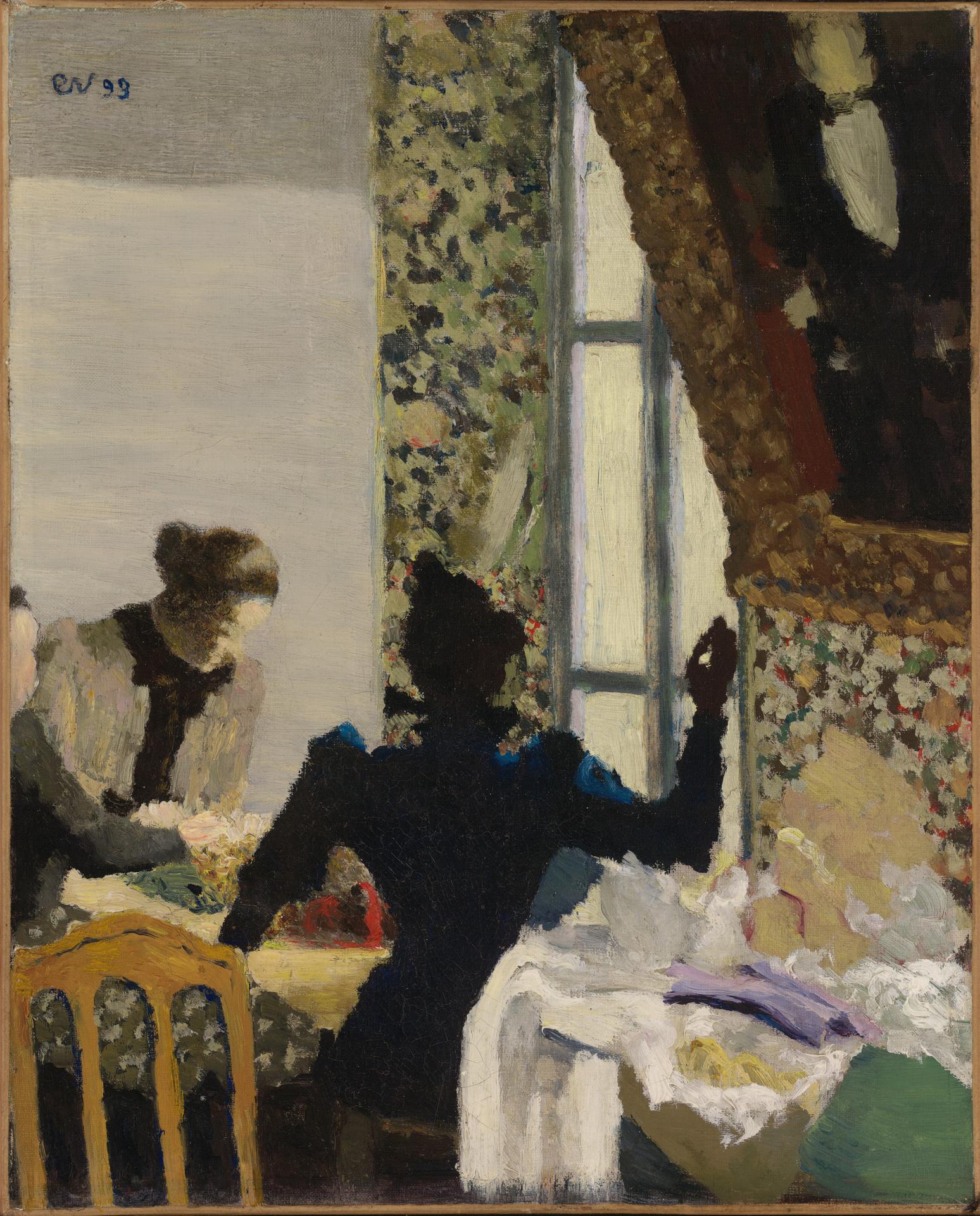
Vuillard and the Silhouette

"Interior with Women Sewing"
Oil on Canvas, 15 7/8 x 12 11/16 inches
Édouard Vuillard, 1893 


Faithful readers know that Édouard Vuillard is one of my favorite painters, and one who greatly inspires me.  I've been revisiting some of his work, and exploring his use of the silhouette.  Truly masterful!  


The top image is variously called "Interior with Women Sewing" or "L'Aiguilée" ("The Needle").  Oh, wow, I can just feel that hand with the needle pulling the thread taut.  The central figure has such a strong gesture.  There are actually three women in this painting, but the silhouettes of the ones on the left serve merely to bring you eye to the main actor in the center.  It's a masterpiece of composition and sparing use of shapes.


"Beneath the Lamp"
Oil on Canvas, 12 1/2 x 15 3/4 inches
Édouard Vuillard, 1892

The next one is also full of lessons for us lesser mortals.  There is a lot of "busy-ness" in the interior decor, but the power of the two female silhouettes create unity and harmony.  There are a lot of lost edges, where the women's silhouettes fade right into the darkness of the room.  As a result, only partial silhouettes remain.  And even then, they are so powerful!  I also think the silhouettes of the chairs are wonderful compositional tools.  They define the area of interest, and bring our eye in a circle. 


"Seamstress"
Oil on Panel, 9 1/4 x 13 1/2 inches
Édouard Vuillard, 1892-95


And the silhouette doesn't need to be blackened.  This last painting shows how a simple, un-modeled figure in silhouette can anchor a painting.  Again, the interior space is replete with details and small shapes of color.  Almost dizzying to the eye.  But the solid form of the central figure holds everything together.  Such a beautiful piece of magic.

If you are interested in more about silhouettes, and especially Vuillard's, check out this post from a few years ago.  Happy reading! 


Tuesday, February 7, 2023

Museum Moment!