Showing posts with label Degas. Show all posts

Saturday, October 24, 2020

Salute to the Silhouette


"Woman at a Window"
Oil on Canvas, 72 x 47 cm
Edgar Degas, 1875-78

One of the greatest revelations during the course my painting instruction has been the power of the silhouette.  Surprisingly, I was told (and found it to be true) that if you paint the space AROUND your subject, you can practically skip painting the subject itself.  The viewer's eye tends to fill in all the missing information. And if the "background" forms an interesting shape around the subject, like it does in the painting below, the viewer's eye is completely enthralled.


"Madame Camus with a Fan"
Oil on Canvas, 72.7 x 91.1 cm.
Edgar Degas, 1869-70

One artist who used this phenomenon to great advantage was Edgar Degas.  His backlit figures are breathtaking.  Degas' "Woman at a Window" (top photo) is a masterpiece of simplicity--and yet it conveys plenty of detailed information.  He tells us just enough, and our experience in the world fills in the rest.

"Grandmother Michaud in Silhouette"
Oil on Canvas, 65 x 54 cm
Édouard Vuillard, 1890

Édouard Vuillard was also a master of this approach.  Who can leave his portrait of his grandmother (immediately above) off the "Best Hits" list when it comes to silhouettes?  This particular painting is almost a classic side profile, which we commonly call "silhouettes". But keep in mind that many of these paintings are not simple side profiles, but rather show figures in full volume.  


\
"In the Lamplight"
Oil on Canvas, 37.5 x 45.5 cm
Édouard Vuillard, 1892

Vuillard's women in the lamplit room is an another example of the power of the outlined form.  Simple shapes of color are all we are given to describe these two women.  There is absolutely no modeling of their figures. Yet we know exactly what they are doing, and can take a good guess at the fabric of the clothes they are wearing.  


"Intérieur au Cannet"
Pierre Bonnard, 1938

The power of the silhouette is effective in still lifes and other subjects, as well as human figures.  I'll conclude with a painting by Pierre Bonnard, showing an room with an open window.  Even though the table and chair--even the walls and bed--are scarcely painted, we understand exactly what they are and where they are placed.  It goes to prove the maxim that sometimes "less is more"!


Tuesday, May 5, 2020

Solitude Found

Portrait of R. M. Rilke by Helmut Westoff

During the coronavirus quarantine, it has occurred to me that asking an artist to social distance is like asking a bird to fly. At least that's been the case for me. Solitude is a prerequisite for good work, and forward progress. In light of the current circumstances, and at the suggestion of a faithful reader, I'm reprising an earlier post on the topic of solitude.  Read on for the 2017 post.  It has new meaning these days!


"Seeking Some Solitude"

I have become convinced that creativity flourishes best when one has ample time to spend in solitude. Part of my conviction comes from reading Rainer Marie Rilke's book, Letters to a Young Poet, in which Rilke explores solitude as the foundation for all genuine artistic work. He writes that to develop your unique voice, you must know and trust your own self, and avoid outside influences. All progress "must come form deep within and cannot be forced or hastened." Rilke writes that "What is necessary...is only this: solitude, vast inner solitude. To walk inside yourself and meet no one for hours."


"Studio Door"
Oil on Linen, 14 x 9
(c) Lesley Powell 2020
Rilke sees in solitude not a wasteland, but instead a vast and rich territory, just waiting to be explored. Solitude allows each of us to call forth memories, dreams, images, impulses and 
reactions which are ours and ours alone. These are the things that form the basis of our work.


"After the Bath"
Pastel on Paper
Edgar Degas, 1893-97

Rilke's thoughts are not unlike those of Edgar Degas. Here are the words of Degas: "It seems to me that today, if the artist wishes to be serious — to cut out a little original niche for himself, or at least preserve his own innocence of personality — he must once more sink himself in solitude. There is too much talk and gossip; pictures are apparently made, like stock-market prices, by competition of people eager for profit... All this traffic sharpens our intelligence and falsifies our judgment."


"Apples VI"
Oil one Linen, 7 x 10
(c) Lesley Powell 2020
(Sold)
BBoth Rilke and Degas were writing over a hundred years ago. I wonder what they would think of today's hyper-connected world. With iPhones always at our sides, and social media such as Pinterest and Instagram bombarding us with countless images, is it even possible to avoid outside influences nowadays? To paraphrase the rock song, "Solitude Just Keeps Getting Harder to Find!" 

Solitude comes in many forms. I'll close with a quote from Brenda Ueland, from her book If You Want to Write: A Book About Art, Independence and Spirit: "Imagination needs moodling--long, inefficient, happy idling, dawdling and puttering." She makes it sound so easy!


Monday, July 10, 2017

Seeking Some Solitude

Portrait of R. M. Rilke by Helmut Westoff

I have become convinced that creativity flourishes best when one has ample time to spend in solitude. Part of my conviction comes from reading Rainer Marie Rilke's book, Letters to a Young Poet, in which Rilke explores solitude as the foundation for all genuine artistic work. He writes that to develop your unique voice, you must know and trust your own self, and avoid outside influences. All progress "must come form deep within and cannot be forced or hastened." Rilke writes that "What is necessary...is only this: solitude, vast inner solitude. To walk inside yourself and meet no one for hours."

Rilke sees in solitude not a wasteland, but instead a vast and rich territory, just waiting to be explored. Solitude allows each of us to call forth memories, dreams, images, impulses and

reactions which are ours and ours alone. These are the things that form the basis of our work.


"After the Bath"
Pastel on Paper
Edgar Degas, 1893-97

Rilke's thoughts are not unlike those of Edgar Degas. Here are the words of Degas: "It seems to me that today, if the artist wishes to be serious — to cut out a little original niche for himself, or at least preserve his own innocence of personality — he must once more sink himself in solitude. There is too much talk and gossip; pictures are apparently made, like stock-market prices, by competition of people eager for profit... All this traffic sharpens our intelligence and falsifies our judgment."


BBoth Rilke and Degas were writing over a hundred years ago. I wonder what they would think of today's hyper-connected world. With iPhones always at our sides, and social media such as Pinterest and Instagram bombarding us with countless images, is it even possible to avoid outside influences nowadays? To paraphrase the rock song, "Solitude Just Keeps Getting Harder to Find!" 

Solitude comes in many forms. I'll close with a quote from Brenda Ueland, from her book If You Want to Write: A Book About Art, Independence and Spirit: "Imagination needs moodling--long, inefficient, happy idling, dawdling and puttering." She makes it sound so easy!


Thursday, January 21, 2016

Pantone's Color of the Year 2016


Well, it's not exactly breaking news, since we are three weeks into the New Year. Nonetheless, it's time to take note of Pantone's "Color of the Year" for 2016. This year's choice is "ROSE QUARTZ".  I should note that this year, Pantone actually named two colors. The other is a baby blue, called "Serenity". As some pundits have said, 

Friday, December 11, 2015

The Poetry of the Process

"Miss La La at the Cirque Fernando"
Oil on canvas
Edgar Degas, 1879
I recently purchased an out-of-print book about Edgar Degas (copyright 1984). I love the book because it takes a long look at the process behind his work. It is filled with pages from his sketchbooks, and studies for his paintings. No "coffee table book" this! Forget the big glossy photos--this is more like a tour through the mind and method of one of the Greats.

Degas' Sketchbook

I especially love the book's presentation of the notes that Degas made to guide him in completion of his paintings. I often jot down notes on site to hep me remember the scene later. But Degas was a real master of this. Here is an example from one of his notebooks. The notes are for the painting above. They are presented as a poem in free verse, and I think they are nothing short of poetic.  Leave it to the Master to make poetry as a byproduct of sharpening his seeing skills!

garnet band
on the bow
string of gold
bright green band
frame
gleam on the column
somewhat low

Golden yellow
Ornaments
as yellow
Golden yellow
blue dark green band
ditto white
narrow part blue green like the farms

reddish yellow
as far as the windows
the white underneath
the porticos is
brighter because of the
little chandeliers 
cornice
light
rose window gold sparkling green


PS: For the curious, the name of the book is Degas: form and space, ed. Jacqueline and Maurice Guillaud.


Monday, June 22, 2015

90% Perspiration

Self Portrait
Eugene Delacroix, 1837
We are all familiar with the old saying that the achievement of success is 10% inspiration and 90% perspiration. Part of the deal is showing up to work, every day, whether one is feeling particularly inspired or not. I am fond of another 90/10 expression, which goes something like this:

Monday, June 30, 2014

The Collector's Eye

Jean Planque, Collector
Several years ago in Aix-en-Provence, I happened onto an exhibition of paintings collected by Jean Planque. And what a happening! My friend and I had never heard of Jean Planque, and we were both astounded by the breadth and power of his collection. We almost hyperventilated!
"Buste de femme endormie"
Pablo Picasso, 1970
Planque came from a peasant family, hard-working and poor. After many business failures,  he eventually became rich from inventing a concentrated cattle feed. His new wealth enabled him to collect art, yet he remained very discerning about his expenditures. He would ask whether "the paintings he considered buying could feed him all his life, as a field of potatoes can feed a family." I have seldom heard a better way of putting this concept--that man does not live by bread alone, but that art also feeds him.

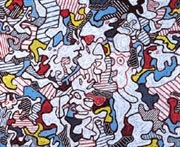
Dubuffet
"Opera Bobeche", 1963
A well know gallery owner, Ernst Beyler, eventually hired Planque to locate and acquire paintings. The gallery owner realized that Planque had an eye that was unequalled, and that he formed genuine relationships with many great artists of the time. Planque was indeed a sort of "matchmaker" within the art world.


"Tour Eiffel"
Robert Delauney, 1928
Planque was also an aspiring painter himself. As such, he could relate to the struggles and achievements of the artists from whom he collected. He became friends with Picasso, Dubuffet, Braque and other greats of the 20th century. It was said that Planque "merely collected the paintings that he wished he had painted". That thought gave me a frisson of excitement. No wonder his collection was so personal. Planque said that the Van Gogh below might not have been the master's greatest work, but it was beautiful, and it was Planque's chance to own his own Van Gogh!


"Bouquet de fleurs"
Vincent van Gogh, 1886-67

Some of the materials on the exhibition noted that it was Planque's "intuition and capacity for wonder that gave rise to such an unusual, illustrated life story". Yes, just touring the collection was in fact a "life story". For behind each painting there is a history, an anecdote, a friendship with the artist. I especially liked this wall, which showed the paintings of Picasso, Braque and others exactly as they were arranged on the wall of Planque's bedroom in Switzerland:


The good news is that this exhibit is now on view in Aix for fifteen years--so you can see it if your plans take you there. It is a new development, so it is not yet in many guidebooks. Here's the info on where to find it


"Deux femmes au bain"
Edgar Degas
If you can't make it in person, here's a UTube video of the 2011 exhibition. Bear with the French, and you can skip ahead to see the show starting about 1.5 minutes in.

I will close with one of Planque's own paintings. It makes me wish that he had abandoned himself to painting his own vision, in addition to collecting...


"Fenetre sur le Luxembourg"
Jean Planque, 1952


[Quotes are from materials printed by Musee Granet in connection with the 2011 exhibition.]