Showing posts with label Impressionism. Show all posts

Thursday, May 16, 2019

Sorolla Fans Rejoice!


"Maria dressed as Valencian Peasant Girl" (detail)
(c) Sorolla 1906
Faithful readers know that I am a huge fan of the Spanish painter Sorolla (or Joaquin Sorolla y Bastida, if you must know the full name!). Sorolla is perhaps one of the least well know of the great Impressionists these days. He achieved great recognition during his lifetime (1863-1923), but has faded into relative obscurity, especially outside of Europe.

"Women Walking on the Beach"
Sorolla, 1909
But there is good news for all Sorolla fans: The National Gallery in London has mounted a major Sorolla exhibition that is hanging right now. It runs until July 7, 2019. This is the first major exhibit of his work in England in over a century. Entitled "Sorolla: Spanish Master of Light", this exhibit should prove to be a giant step in bringing his work back into the forefront.

"Sewing the Sail"
Sorolla, 1896
The London exhibit includes over sixty works. One third of them are from private collections all over the world--I love to see paintings from private collections, because it is such a pleasure to confront new work that has not been featured time and time again in books and magazines. I especially like to see the miracles that Sorolla could work with whites. The two paintings immediately above are like a master class in seeing and painting white!


"Garden Grotto, Alcazar de Seville"
(c) Sorolla, 1910
Sorolla painted all sorts of subjects with equal ease and élan. From landscapes to portraits, from peasants to aristocracy, it seems as if he could do anything. And like all greats, he made it look so effortless! But we know from his studies (many of which will be included in the exhibit) that much behind the scenes work was done to lay the ground for the bravura strokes that would make the finished painting.

"Alahanbra, Granada"
Sorolla, 1910
For those of us who can't make the journey to London, there's a beautiful four minute video showing the exhibition, which you can see here. Or if you are in New York, don't miss his fantastic cycle of paintings at the Hispanic Society--learn about it here. Enjoy!

"A Street in Granada"
(c) Sorolla, 1910

Saturday, August 19, 2017

Look Up!

"Honfleur"
Eugene Boudin

Lately the weather has provided my area with lots of interesting clouds (and summer thunderstorms). Watching the shifting clouds, I thought it would be timely to write about skyscapes. In the painting world, several artists are known for their skyscapes. The one who is first in my mind is the French painter Eugene Boudin. He was called "King of the Skies" by none other than the great Camille Corot.  Boudin lived in Normandy, and if you have been there you know that the skies are very active. No shortage of cloud formations!

"Grand Ciel"
Oil on Wood, 26,8 cm x 21. 8 cm
Eugene Boudin, c. 1888-95

Boudin's paintings of skies range widely in approach. Some are highly finished and carefully rendered. Others are very gestural, almost unfinished. When painting skies, you have to move quickly, and often the rapidly executed, somewhat unfinished paintings of clouds are the most appealing to me.  As Nicolaides wrote in his seminal book on drawing, "The clouds

Saturday, June 24, 2017

Revolution in a Tube

"Blue & Yellow"
6 x 8
(c) Lesley Powell 2013

Ah, the humble paint tube. We take metal (and now plastic) screw-top tubes for granted nowadays. They appear everywhere, holding everything from toothpaste to ointments. But they were a breakthrough in their time, and revolutionized the course of painting. Renoir is quoted as having said "Without colors in tubes, there would be no Cezanne, no Monet, no Pissaro, and no Impressionism".

Why was the paint tube revolutionary? Two reasons: (1) it let you re-seal paint to keep it fresh, and (2) it let you take the paint outside the studio and work en plein air. For today, I am going to focus on #1.


Re-sealing the paint was a huge development, because oil paints start to dry out and harden as soon as they are exposed to air. Once exposed to air, paint will only stay useable for a day or two at most. Before the mid-1800's, artists stored their paint in pigs' bladders to

Wednesday, August 17, 2016

Ahead of his Time?

"The Scarlet Sunset"
Watercolor and Gouache on Paper
JMW Turner, circa 1835-40

While in Aix-en-Provence this summer, I visited a special exhibition featuring the works of the great British artist JMW Turner.  True confessions: there was so much to see and learn from the exhibit that I went twice! The exhibit was titled "Turner and Color", and boy was that an apt title.

"Impression, Sunrise"
Oil on Canvas
Claude Monet, 1872 

Much has been written about Turner being a precursor of the Impressionists. Turner died just eleven years after Monet was born, so most of Turner's career transpired before the great Impressionist "revolution" got underway. Yet for Turner, as for the Impressionists, the effects of color and light were far more important than the illustrative aspects of a painting. He invented a way of painting that got his point across without showing pictorial details. In-

Sunday, December 6, 2015

Art of the Garden

"Woman Reading by a Window"
Gari Melchers
Showing now at Reynolda House Museum of American Art in Winston-Salem, NC: a wonderful exhibit entitled "The Artist's Garden: American Impressionism and the Garden Movement, 2887 - 1920"I saw the exhibit recently, and felt like I had made the acquaintance of some artists who were new to me, and had also visited with some artists who are "old friends". 


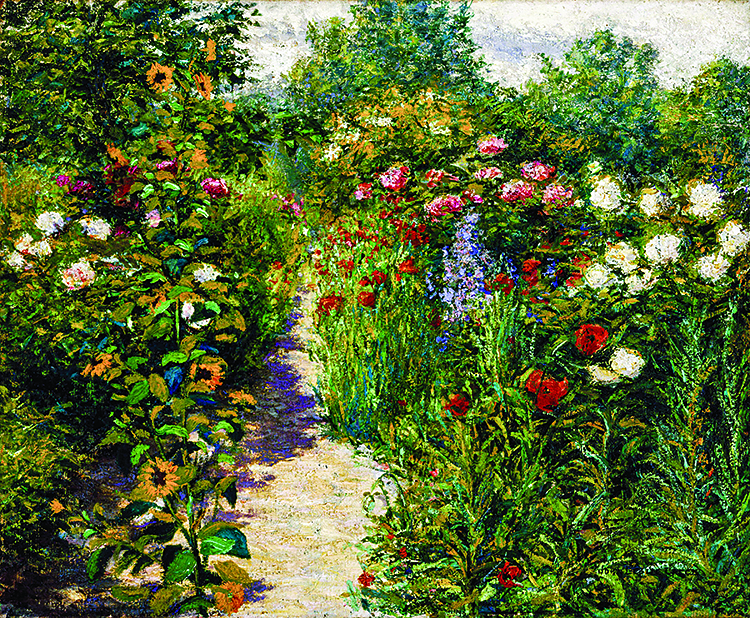
"Garden at Giverny"
John Leslie Breck, 1887-1891
Starting in the 1880's, quite a few American painters travelled to France. They were drawn to Giverny, Monet's home and gardens. Many of them became neighbors of Monet and painted right alongside him. The influence of the French Impressionists on these American painters is unmistakeable. Thanks to the recent invention of the paint tube, they were able to paint outside. In fact, Breck's painting above was painting in Monet's garden. No longer  confined to the studio, these artists were intent on

Tuesday, May 26, 2015

That Touch of Red

"By the Sea, Honfleur"
Pastel on canvas, 45 x 37 cm
Eval Gonzales, 1881
I have often noticed how one small splotch of red in a painting can make all the difference. A dot of red can attract the viewer's eye, and direct the visual journey through the painting. It can draw attention to a focal point. In a painting that is otherwise composed of cool or subtle colors, that bit of red can serve as a counterpoint that makes the other colors come alive. Given my fascination with red, I was interested to come across an essay about the Impressionist painter Eva Gonzales, and her use of red. It was entitled "Expressive Red". **

The top painting is a wonderful example of using red in a carefully managed, restricted way. The painting is mostly cool blue/green colors. But the painter picked out a detail of the clothing, two thirds of the way up the height of the canvas, and used red as a "revealer". Voila! The red bow

Wednesday, April 29, 2015

Flower Power

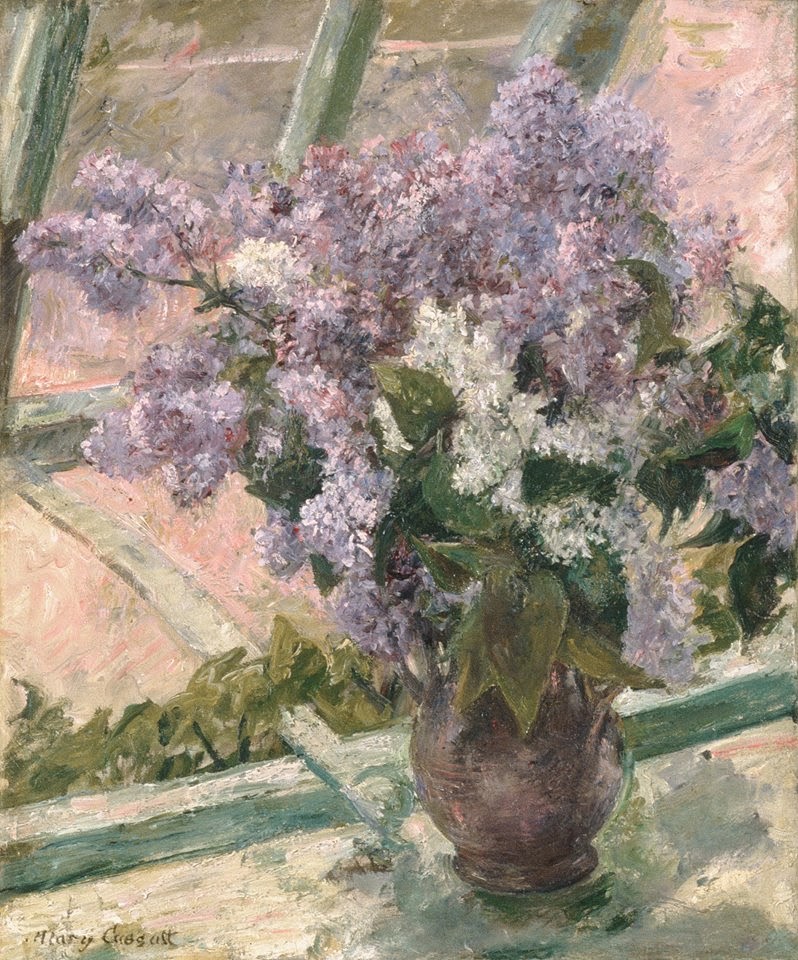
"Lilacs in a Window"
Mary Cassatt, 1879
Up now at the Virginia Museum of Fine Arts in Richmond: "Van Gogh, Manet,and Matisse: The Art of the Flower". I recently saw the exhibit, and was impressed with its breadth. There were masterworks from museums such as the Louvre and the Musee d'Orsay in Paris and the Van Gogh Museum in Amsterdam. It's definitely worth a detour to catch this one. One might ask, "How many pictures of flowers can a person look at in one show??". No problem for me--the subject matter is not so important, because

Monday, January 27, 2014

A Moment in Time

"The Cliff, Etreat: Sunset"
(c) Claude Monet, 1883
The Impressionist movement in painting was all about capturing a moment in time--nailing down the fleeting effects of sun and light at a particular place and time. In fact, recording something real and immediate was at the heart of Impressionism. It was the reason that so many Impressionists left the studio to paint directly in the landscape, and the reason they worked so quickly to capture conditions before they changed.

Now, in breaking news, a team of scientists have just announced that they have successfully pinpointed the exact moment depicted by the great Impressionist Claude Monet in the painting that you see above. The verdict: 4:53 pm, on February 5, 1883. 


(c) Sky & Telescope Magazine
The scientists' sleuthing involved travel to Normandy, and use of both high tech and low tech resources--a sextant (shown above), a laser rangefinder, letters written by Monet, records of tides, and weather information, to name a few. You can read the full story in Sky & Telescope Magazine (February 2014 edition).  Meanwhile, here's a photo from the magazine showing how the scientists used other Monet paintings of the same shore to find the spots that Monet must have stood to paint his series. What inspiring vistas!


(c) Sky & Telescope Magazine
PS: For those of you in NC, the top painting is in the collection of the NC Museum of Art in Raleigh...worth a detour to take a look.


Friday, October 25, 2013

Seeing Light

"On High", 24 x 30
Available at Huff Harrington Fine Art
I recently posted on Impressionism and its emphasis on painting light, in a piece called "What's in the Tube". After posting, I thought about a couple of my own paintings that were illustrations of this approach--capturing the fleeting effects of light.

The top painting is a large one, done in my studio from a plein air study. The warm colors, the hint of sunset in the sky, and the sandy, rocky ground tell you about a moment in time, and a place in time. It is just before sunset, above a perched village in the Luberon (in the south of France).

In contrast, the painting below shows the same subject, and was painted the same day as the first painting, but the light had changed completely. The sun had disappeared behind the clouds and everything was gray. One viewer said "Just because it's cloudy doesn't mean it has to look like the Addams Family lives there!". Point taken. But--I was painting what I saw. (Sorry for the odd angle of this photo).

"On High, Cloudy"
Just to complete the cycle, here is a final painting of the same subject, painted in the middle of the afternoon with the sun out. As you can see, with this Impressionist approach the same scene can be an infinite number of paintings, depending on the time of day, the time of year, and the weather. Stay tuned for more examples!

"On High, Sunny Afternoon"
5.5 x 10.5, Oil on Canvas

Thursday, September 26, 2013

What's in the Tube


A thoughtful reader recently wrote me about my post on the invention of the metal paint tube. She pointed out that it was not so much the tube itself that gave birth to Impressionism, but rather what was IN the tube. Yes, indeed.  It is no mere coincidence that the Impressionist movement came at the same time as the Machine Age and the industrialization of Europe. In fact, breakthroughs in chemistry and physics gave us a huge number of new pigments, as well as a new way of understanding light and color. Together these were the catalyst for an entirely new way of painting.


The years between1825 and 1870 saw the invention of at least ten new pigments. Among them were colors that became staples of the Impressionist palette, such as cobalt yellow, artificial ultramarine blue, cobalt blue, cerulean, viridian, alizarine and zinc white. Most of these pigments were very opaque. Their opacity meant that, instead of having to use layer upon layer of thin paint to build up color, as had traditionally been the case, painters could cover the canvas in a much shorter time. They could thus capture a scene quickly, even in one or two sessions outdoors on location.


Eugene Boudin (1824-1898), on location

These years brought us not only new colors, but also new theories of color. Eugene Chevreul, an industrial color chemist, wrote extensively about the nature of color and light. He articulated the law of "simultaneous contrast", by which a color appears brighter and more intense when placed next to its complement. Here's an illustration:


Other chemists were expanding on the work of Isaac Newton, who had shown by using a prism that white light contained all other colors of light. Nowadays we take this idea for granted, having seen the illustration below since we were children. But it was a new concept at the time.


Impressionism was born in the midst of--or perhaps even as a result of--these breakthroughs. There was a new understanding of how we see light. At the same time, that there were new paints which would allow painters to work quickly to capture the fleeting effects of light. No wonder that with Impressionism, light itself became the subject of paintings. As said in the North Carolina Museum of Art's "Revolution in Paint","The Impressionist came to see the world as flicking light and color, a jumble of prismatic light reflected to our eye. The pigments on their palette were not just colors; they were the ingredients of light."

I think that Monet's series of paintings of the Rouen cathedral is a great illustration of how the Impressionists painted light. Take a look at the examples below. It is clear that Monet is not just painting the cathedral facade---he is painting the LIGHT on the facade. And so a new way of painting is born...


"Rouen Cathedral, Facade and the Tour d'Albane, Gray Weather", 1894

"Rouen Cathedral, West Facade, Sunlight", 1894

"Rouen Cathedral, Setting Sun", 1894

Stay tuned for upcoming installments on technical advances in paint manufacture, and other theories of color and color perception--and how they changed the way we paint.

Tuesday, August 6, 2013

Ode to the Paint Tube

"Blue & Yellow"
6 x 8
(c) Lesley Powell 2013

Ah, the humble paint tube. Seems a very ordinary thing nowadays, but it was a breakthrough in its time, and it revolutionized the course of painting. Renoir is quoted as having said "Without colors in tubes, there would be no Cezanne, no Monet, no Pissaro, and no Impressionism".

As you may may know, oil paint begins to dry out and harden as soon as it is exposed to air. It might stay useable for a day, or two at most. Before the mid-1800's, artists stored their paint in pigs' bladders to avoid exposing it to the air. The bladders were notoriously messy, and tended to burst. They were opened by piercing with a tack. Once opened, they could not be resealed. As you can imagine, the bladders were far too undependable to transport outside the studio.

All of that changed with the advent of the metal paint tube. And we owe it to a fellow Carolinian--John G. Rand, from South Carolina--who patented it in 1841. The metal of the tube was impermeable, and with the screw-on lid it would stay airtight. You could open and close the tube as often as you wished, without the paint spoiling. 


L: Pig's bladder filled with Prussian Blue paint
R: Paint tube
(Photo courtesy V&A Museum)

The first revolutionary aspect of this invention was that paint would last almost indefinitely. Before the tube, when an artist opened a bladder of paint, he needed to use it all before it spoiled. (Oil paint has always been, and still is, quite expensive, and nobody can afford to waste it). Thus, painters of old would paint all of the blue areas of a painting when they opened the bladder of blue--needing to finish before the paint oxidized. Then they would move on to the next color, and do the same. 

With the advent of the tube, painters could open all of their pigments at once. No more worry about wasting paint--the right quantity could be squeezed from the tube, and the tube could be resealed to preserve the rest.  As the publication of the NC Museum of Art says: "Now the painter could work anywhere on the painting's surface at any time...This was absolutely crucial with the Impressionists. They needed to work very quickly to capture fleeting effects of light and weather. This required an intuitive immediate response which could not be limited to one small part of a larger composition."

Here are two paintings by Claude Monet, one of the great Impressionists. Can you imagine painting either one of these if you had to paint all of your blues first, then all of your reds, etc? Impossible!


Monet: "Les Tilleuls a Poissy"

Monet: "Le Grand Canal"

Working all over the canvas simultaneously, as you can see in the above images,  is a hallmark of the Impressionists. Camille Pissarro advised  "Don't paint bit by bit, but paint everything at once by placing tones everywhere." In my own practice, going back and forth between different areas of the canvas is essential to getting the color relationships right. Every color affects the others, especially those close to it, and I cannot imagine how hard it would be to get the relationships right if painting all of each color, one by one.


Eugene Boudin
Painting en plein air
19th century

The second revolutionary aspect of the tube was that paint was now portable. Artists could now paint en plein air, outside on location. More on that in a future post. Stay tuned!