Showing posts with label figures. Show all posts

Wednesday, March 22, 2023

Vuillard and the Silhouette

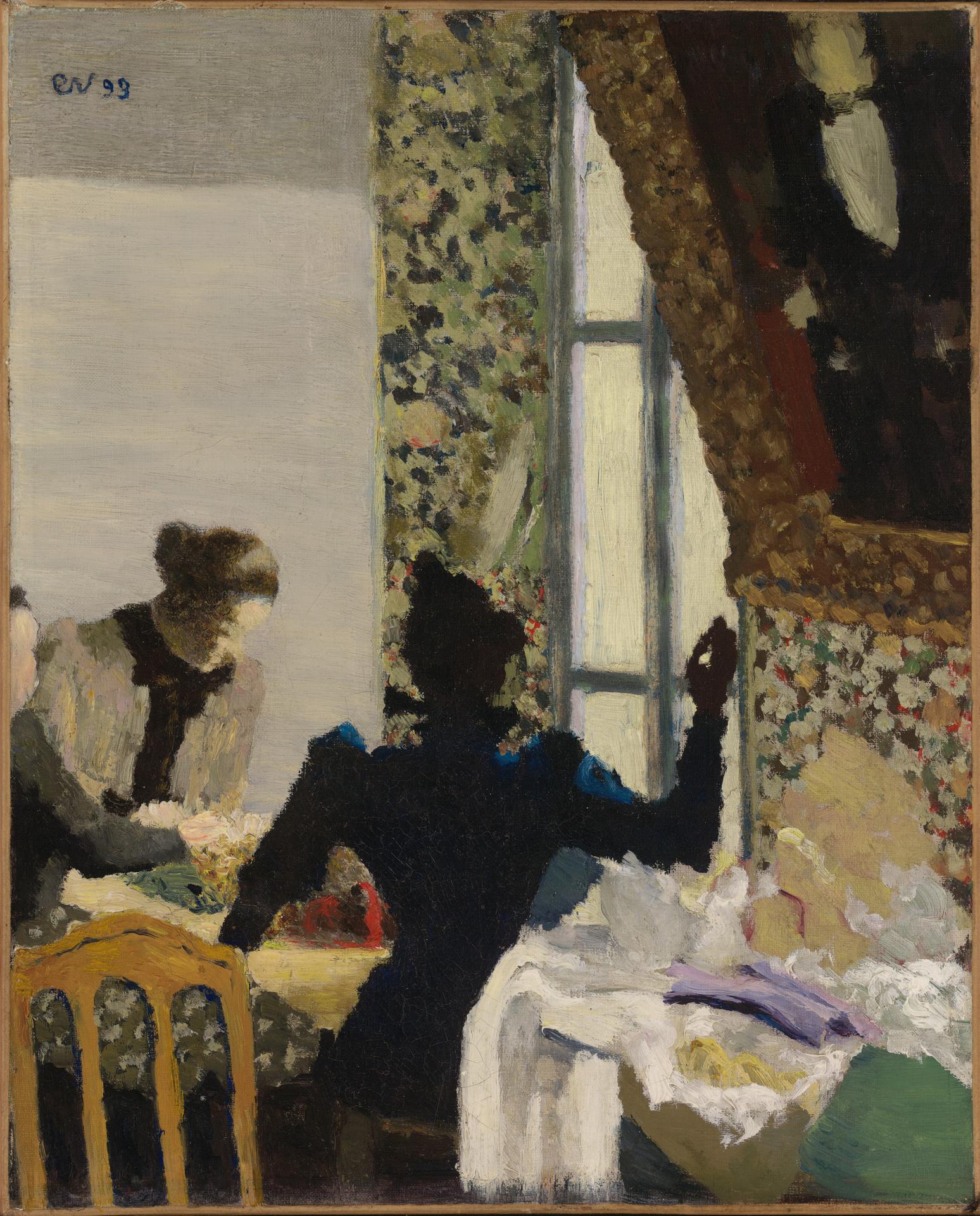
"Interior with Women Sewing"
Oil on Canvas, 15 7/8 x 12 11/16 inches
Édouard Vuillard, 1893 


Faithful readers know that Édouard Vuillard is one of my favorite painters, and one who greatly inspires me.  I've been revisiting some of his work, and exploring his use of the silhouette.  Truly masterful!  


The top image is variously called "Interior with Women Sewing" or "L'Aiguilée" ("The Needle").  Oh, wow, I can just feel that hand with the needle pulling the thread taut.  The central figure has such a strong gesture.  There are actually three women in this painting, but the silhouettes of the ones on the left serve merely to bring you eye to the main actor in the center.  It's a masterpiece of composition and sparing use of shapes.


"Beneath the Lamp"
Oil on Canvas, 12 1/2 x 15 3/4 inches
Édouard Vuillard, 1892

The next one is also full of lessons for us lesser mortals.  There is a lot of "busy-ness" in the interior decor, but the power of the two female silhouettes create unity and harmony.  There are a lot of lost edges, where the women's silhouettes fade right into the darkness of the room.  As a result, only partial silhouettes remain.  And even then, they are so powerful!  I also think the silhouettes of the chairs are wonderful compositional tools.  They define the area of interest, and bring our eye in a circle. 


"Seamstress"
Oil on Panel, 9 1/4 x 13 1/2 inches
Édouard Vuillard, 1892-95


And the silhouette doesn't need to be blackened.  This last painting shows how a simple, un-modeled figure in silhouette can anchor a painting.  Again, the interior space is replete with details and small shapes of color.  Almost dizzying to the eye.  But the solid form of the central figure holds everything together.  Such a beautiful piece of magic.

If you are interested in more about silhouettes, and especially Vuillard's, check out this post from a few years ago.  Happy reading! 


Tuesday, February 1, 2022

Go Figure

Untitled
19 x 11, Oil on Linen
(c) Lesley Powell, 2022


I try to chose topics for this blog that are of wide-ranging, general interest, and to avoid making it all about my own paintings.  That said, it's been a while since I showed you the latest things off my easel, so I'd like to remedy that lapse.  Recently, I've been working on a series that features the human figure AND the drape of textiles.  


"Still"
16 x 12, Oil on Linen
(c) Lesley Powell, 2022

Sometimes I don't know which is the greater challenge:  getting the figure to be believable, or getting the drape of the fabric to be believable.  When both elements come together, it is definitely a "Eureka" moment.   To quote Kent Nerborn: "[E]ach stroke on the canvas is, in the moment of its making, a great affirmation, a great and courageous 'Yes!'.  It is you taking a leap of faith and saying, 'Of all the choices I could have made, I chose you."  I might add that it takes many leaps of faith to make a painting!


"Brunette"
20 x 16, Oil on Canvas
(c) Lesley Powell, 2022

I am not a student of anatomy, and I don't strive to make these figures perfectly "accurate" in terms of musculature and skeletal formation.  Instead, my focus is on how the light creates shapes of shadow, and how the model's flesh tones vary from warm to cool, and from light to dark.  Using this approach, the figures become somewhat abstracted. In fact, I love the process of abstracting slightly from reality, so that the viewer's imagination is brought into play. 


"Unposed"
16 x 12, Oil on Linen
(c) Lesley Powell 2022


Some of these paintings are on their way to Huff Harrington Fine Art in Atlanta, others are available in my studio.  I hope you will enjoy taking a look.


Sunday, March 7, 2021

Mudheads


What, you might ask, is a "mudhead"?  No, it's not a derogatory term for a dull person.  In the world of art, a "mudhead" is a particular type of painting, one that shows faces and figures in a quasi-abstract, often colorful manner.  The term originated with the great artist Charles Hawthorne, who founded the Cape School of Art in Provincetown, MA, right around 1900.  Nowadays, vintage mudheads painted by Hawthorne's students are prized, and are highly collectible. 


Hawthorne era mudhead; Anonymous 

Hawthorne taught a revolutionary approach to painting the figure.  He had his students paint from live models, in bright sunlight on the beach.  The students were told to paint only the broad patterns of light and shadow, and not get bogged down in details.  This approach allowed the painter to capture the color, value and form of people, without rendering their facial features.  In many ways, it became the backbone of modern painting, emphasizing the fact that the impact of a painting comes from the big shapes, not fine details. 


Carole Smith Myer


A mudhead is usually backlit by very bright light.  With such strong backlighting, the heads and faces appear to be a fairly uniform, warm, muddy color.  Thus the term "mudhead".  To me, the charm of the mudhead is that fact that it is specific, despite also being anonymous.  I love the way these paintings are built from abstract shapes of color.  The big shapes are put down first, and although they may ultimately be refined somewhat, they are never detailed.


Untitled
15 x 14, Oil on Linen
(c) Lesley Powell 2021

I'm illustrating this post with some vintage mudheads, and also an effort of my own.  My painting is from a photo I took in Italy many years ago.  The ladies on the park bench were very strongly backlit, and the features were not discernible.  But I think you can tell a lot about them, nonetheless. I couldn't decide whether to call this one "Support Group" or "Support Hose".  Cast your vote here!


Saturday, October 24, 2020

Salute to the Silhouette


"Woman at a Window"
Oil on Canvas, 72 x 47 cm
Edgar Degas, 1875-78

One of the greatest revelations during the course my painting instruction has been the power of the silhouette.  Surprisingly, I was told (and found it to be true) that if you paint the space AROUND your subject, you can practically skip painting the subject itself.  The viewer's eye tends to fill in all the missing information. And if the "background" forms an interesting shape around the subject, like it does in the painting below, the viewer's eye is completely enthralled.


"Madame Camus with a Fan"
Oil on Canvas, 72.7 x 91.1 cm.
Edgar Degas, 1869-70

One artist who used this phenomenon to great advantage was Edgar Degas.  His backlit figures are breathtaking.  Degas' "Woman at a Window" (top photo) is a masterpiece of simplicity--and yet it conveys plenty of detailed information.  He tells us just enough, and our experience in the world fills in the rest.

"Grandmother Michaud in Silhouette"
Oil on Canvas, 65 x 54 cm
Édouard Vuillard, 1890

Édouard Vuillard was also a master of this approach.  Who can leave his portrait of his grandmother (immediately above) off the "Best Hits" list when it comes to silhouettes?  This particular painting is almost a classic side profile, which we commonly call "silhouettes". But keep in mind that many of these paintings are not simple side profiles, but rather show figures in full volume.  


\
"In the Lamplight"
Oil on Canvas, 37.5 x 45.5 cm
Édouard Vuillard, 1892

Vuillard's women in the lamplit room is an another example of the power of the outlined form.  Simple shapes of color are all we are given to describe these two women.  There is absolutely no modeling of their figures. Yet we know exactly what they are doing, and can take a good guess at the fabric of the clothes they are wearing.  


"Intérieur au Cannet"
Pierre Bonnard, 1938

The power of the silhouette is effective in still lifes and other subjects, as well as human figures.  I'll conclude with a painting by Pierre Bonnard, showing an room with an open window.  Even though the table and chair--even the walls and bed--are scarcely painted, we understand exactly what they are and where they are placed.  It goes to prove the maxim that sometimes "less is more"!


Sunday, April 26, 2020

Face Off


I recently painted a "beret series"--a group of oil sketches featuring French men, women and children wearing berets. Working on this series has enhanced my already great respect for artists who paint figures and portraits. The slightest little angle can change an expression completely--or make the subject go from handsome to ugly. I spent hours  adjusting and re-adjusting eyes and mouths my French folks. And these are just "sketches"!


"Red Beret I"
10 x 10, Oil on Canvas
(c) Lesley Powell 2020

Why are faces so hard to get right? It's largely because the human eye and brain are exquisitely sensitive to very slight changes in human facial expressions. In fact, we have a specialized brain module that is devoted exclusively to processing faces. Because of this specialized module, we have very fine "within-face discrimination". An image that presents as a face is automatically processed by the specialized module. Thus, whenever we see a face, we are geared up to make very fine judgments of very slight differences.


"Boy in Beret"
10 x 10, Oil on Linen
(c) Lesley Powell 2010
For proof, consider the top photo in this post. In it, the faces are shown upside down. They probably look fairly similar to you. Because they are upside down, they don't present to our brains as faces. And because they are viewed as something other than faces, we don't use the specialized "face" module in our brains to interpret them. As a result, we don't make ultra fine distinctions between the images. They look rather similar. But. But! Just look at the photo below. 


When the faces are rightside up, our brains read them as faces, which triggers use of our special module. One glance tells us that things are quite amiss with the woman on the right. Yikes! I can study the top photo at length and not discern these differences. Yet one split second glance at the real photo, and I realize that things are horribly off. What an amazing illustration of the heightened sensitivity with which we view human faces. 

The illustrations of the "face inversion effect" are from Margaret Livingstone's book Vision and Art: The Biology of Seeing. Can't wait to learn more from this book! 


Thursday, January 12, 2017

Anders Zorn

Anders Zorn
"Reveil, Boulevard Clichy", 1892
Watercolor, 36 x 24 cm.

He is called "a painter's painter", ranking right up there with John Singer Sargent and Joaquin Sorolla. There's no question that he was a virtuoso artist. But his name is hardly a household name nowadays: Anders Zorn.  So who is this Anders Zorn? Born in 1860, he was a Swede, and one of the most acclaimed portrait painters of the Belle Epoque era. In fact, he and Sargent painted portraits of some of the same glamorous clients.


Anders Zorn
"Isabella Stewart Gardner in Venice", 1894
Oil, 91 x 66 cm.

I first encountered Zorn's work at the Isabella Stewart Gardner Museum in Boston. It turns out that the Gardner has the finest collection of Zorn's paintings in the United States. I remember to this day how the painting (above) of Isabella Stewart Gardner took my breath away. There is such life in her gestures, and the effect of the light dress against the dark night is so striking. Strong, simple shapes, and  bold gestures. It doesn't get any better than this! (By the way, there's an interesting backstory on this painting, which you can read here.)


Anders Zorn
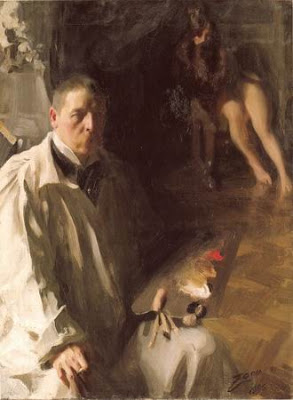
"Self Portrait with a Model", 1896
Oil on Canvas, 49 x 41.3 cm.

There is so much to say about Zorn, but for this post I will focus on his way he painted whites. His whites are completely astonishing. Whether I am looking at the voluptuous folds of fabrics in the top painting, or the artist's smock in the self-portrait just above, I am amazed. The subtle shifts of color are so sensitively observed. At some level deep inside, I can actually feel the fabric just by looking at the painting. I know whether it is soft or crisp, thick or thin.


Anders Zorn
"Emma Zorn Reading, 1887"
Oil, 40.2 x 60.6 cm.

Zorn's magnificent handling of whites is not limited to fabrics. I love the painting of his wife reading the newspaper, above. There are cool shadows where the paper is shaded, and warm areas where there is some light coming through. Gorgeous! Of course, we can't really see a painting very well from a photo. I'm sad to say that I missed the big Zorn shows in New York and San Francisco over the past few years. That's why I'm especially excited that there is a huge retrospective of Zorn's work scheduled for this fall in Paris. Here's a link to the scoop--and here's hoping that a plane ticket could be in my future!


Tuesday, May 27, 2014

Now and Then

"Peasant Woman at Montemurlo"
Oil on Cardboard, 10 x 5 1/2
Vincenzo Cabianca, 1860-62
In the course of my research for the recent post on the Macchiaioli, I came across some wonderful figurative work by Vincenzo Cabianca (one of the Macchiaioli). These 19th century Italian paintings immediately brought to mind the work of

Friday, February 14, 2014

Happy Valentine's Day!

"Bouquet of Roses"
SOLD
(c) Lesley Powell 2014
Happy Valentine's Day! To celebrate the holiday, I wanted to share this painting. I loved the thick impasto paint, and the purposeful stride of the bouquet-bearer.


Wishing you a big bouquet for Valentine's Day!

Tuesday, February 26, 2013

Two for One


"Sargent Gallery"
16 x 16
Oil on Canvas
Available at Huff Harrington Fine Art, Atlanta

I have worked recently on a series of paintings depicting museum-goers. I suppose that's not surprising, since visiting art museums is always at the top of my list when traveling. When the galleries are not too crowded, I enjoy watching the visitors interacting with the art. This sort of scene makes for an interesting painting. I can't decide which is the more challenging aspect--painting the figures of the people in the museum, or painting the paintings they are looking at!

"Red Sneakers"
14 x 11
Oil on Linen
Available at Providence Gallery, Charlotte