Showing posts with label creativity. Show all posts

Tuesday, January 17, 2023

Sketchbook Inspiration

Double Page Spread from Prendergast Sketchbook


Every year I resolve to be more faithful in my sketchbook practice.  This year, I have fueled enthusiasm for my resolution by revisiting another artist's sketchbook--one that was kept by Maurice Prendergast around 1899.  I happened on this little treasure in a used book store, and couldn't resist bringing it home.  It's an exact reproduction of the actual sketchbook kept by Prendergast.  (The original has been donated to the Boston Museum of Fine Arts).  My book lay fallow for a while, but when I eventually delved in, I was delighted.


From Prendergast Sketchbook, 1899


The pages in the Prendergast book are a delight of color and motion--as the accompanying material says, "fleeting impressions of...women  in holiday garb...the edge of the sea, sunlit parks and woodlands....gay parasols over extravagant bonnets".  The Gilded Age, indeed!  The book has both watercolors and pencil drawings.


Interestingly, a number of the watercolors were painted on separate sheets, and afterwards attached to the pages of the sketchbook.  I felt a kinship with Prendergast when I learned that--it sounded like something I might do, rather than plunging right into the sketchbook itself.  Was he cautious about wasting pages of the sketchbook on drawings that didn't work out?  Did he choose the watercolors to attach to the sketchbook because they were the most accomplished (leaving out the rejects, so the book would be pretty)? Or did he choose them because they were seeds of ideas for further paintings, and he wanted to keep them front of mind, and close at hand?
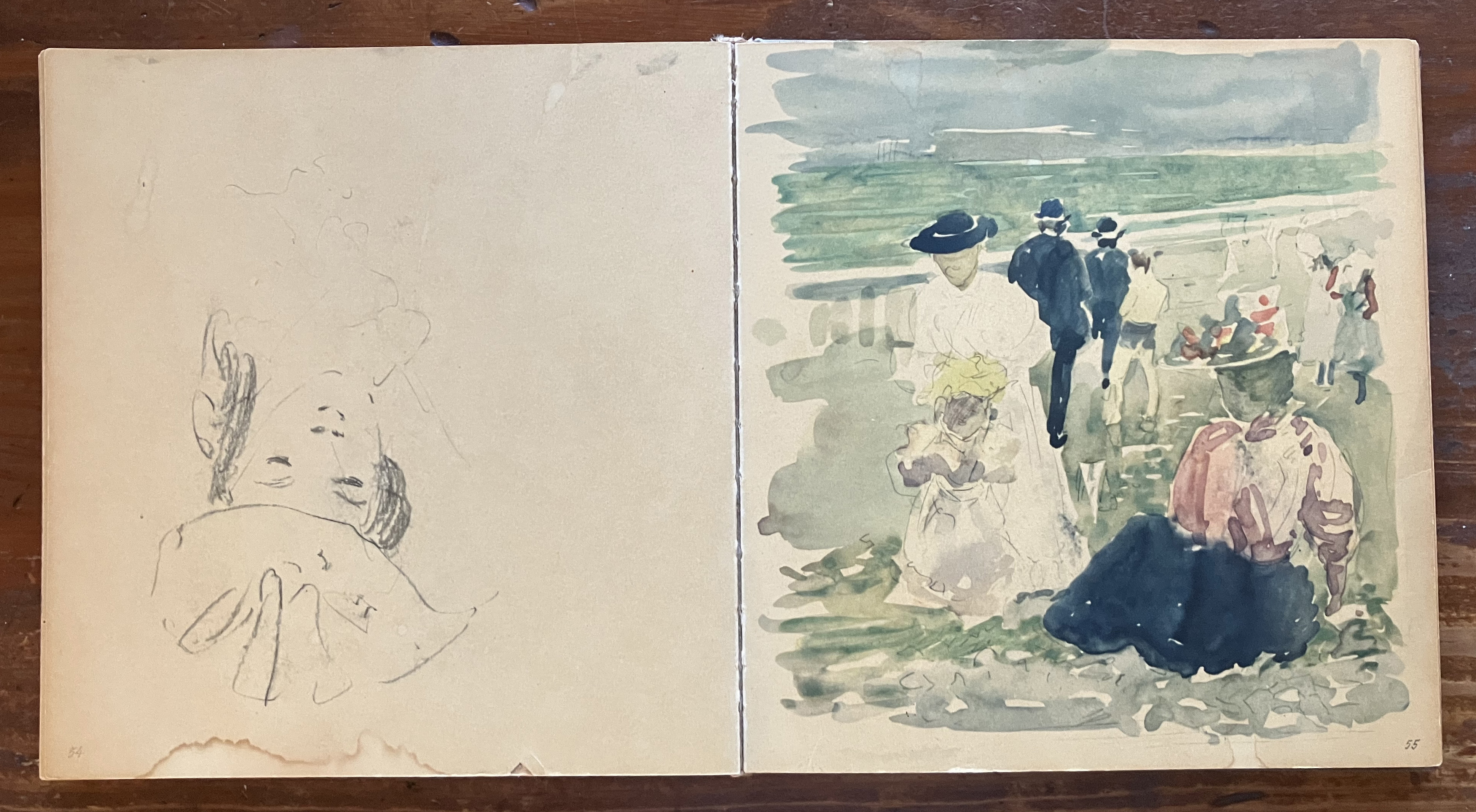


Nevermind the answer to those questions.  The important thing is the practice of keeping the sketchbook. I did some further research online, and was especially inspired by Prendergast's sketches from Paris, like the top image in this post.  I'm planning a trip to Paris this year, and the sketchbook will definitely go with me.  Mine may never be part of a museum collection, but it will still be a treasure to me!


Friday, June 11, 2021

How to Create


 On occasion I come across a book on a subject unrelated to painting, which nonetheless turns out to be a treasure trove of ideas that enhance my studio practices.  One of these is Stephen King's book On Writing.  You don't have to be a would-be novelist to love this book. If you are at all interested in the creative process, or simply in writing well, you will be rewarded by reading this one. I should have included it in my recent post on Summer Reading!


King's book is part memoir, part "how to" on writing. I found the memoir portion to be as instructive as the other parts on the subject of the creative process. His memoir provided proof that if you follow the things that have excited you since childhood, you are tapping into the best and most authentic material.  In King's case, think goblins, gore and things that go bump in the night.  


"Hermitage Road"
Oil on Linen
(c) Lesley Powell 2021

Here are a few quotes from the book that I find especially applicable to my own work. Faithful readers may also find that they contain important life lessons:


"You must not come lightly to the blank page."


"Good writing is often about letting go of fear and affectation."


"Luther Street Bungalow"
8 x 12, Oil on Linen
(c) Lesley Powell 2021

"If you want to be a successful writer, you must be able to describe [the experience], and in a way that will cause your readers to prickle with recognition."


"Description begins in the writer's imagination, but should finish in the reader's."


Untitled
Oil on Linen
(c) Lesley Powell 2021


And a personal favorite, so akin to what I strive for in simplification of my paintings:  "Good description usually consists of a few well chosen details that will stand for everything else."


"Backstage"
6 x 12, Oil on Canvas
(c) Lesley Powell 2021

I'm illustrating this post with some recent paintings, in which I tried to SEE clearly and DESCRIBE with a few details so that the work can be completed in the viewer's imagination.  Enjoy!


Tuesday, January 5, 2021

The Learning Curve


Every serious painter knows this hard truth:  there are many stumbles on the path to improvement, and you must be willing to fall, and then pick yourself back up and start over. Progress can be sporadic (and that's an understatement). Many hours must be put in. Courage and perseverance are key.


I reflected on this truth while reading an article that discussed how babies learn to walk. Toddlers learning to walk are so determined that they travel the length of about eight football fields in ONE HOUR. During that hour, they fall an average of 30 times. It takes 2.6 million steps for them to become proficient at walking. As the article notes, this failure rate would be deeply discouraging (the article even said "catastrophic") for an adult trying to learn a new skill. 

Toddlers persevere in learning to walk because faster, hands-free mobility is thrilling.  Adults persevere in our endeavors because mastery of a new skill is nirvana. 


Toddlers also teach us that learning is not linear.  They often start to walk, and then revert to crawling for a while. Their progress is U-shaped.  In other words, when learning a new skill, we often get worse before we get better.

Another important lesson from the article is that infants learn best "when operating near the limits of their current skill level."  The takeaway for the rest of us is clear:  Always be "at the edge of what you can't currently do."  


"After Degas"
12 x 10, Oil on Linen
(c) Lesley Powell 2020

I've written about the creative process before, and the example of toddlers learning to walk reinforces some of the notions I explored then. It's a nice concrete example to keep in mind as we start the New Year.  Yes, it's frustrating to be at the edge of what you can't currently do--but oh, the rewards are great when you can push that boundary a little bit further!


Sunday, November 15, 2020

Transcribing the Masters

Transcribing from Degas

My last post was about the discovery that Edward Hopper had copied some of his early paintings (previously believed to be originals) from paintings photographed in magazines. Since then, I have been thinking about the difference between "copying" and "transcribing".


"After Degas I'
12 x 10.5, Oil on Linen
(c) Lesley Powell 2020

"Copying" could be called an attempt to make an exact replication of the original. "Transcribing", on the other hand, is not aimed at replicating the original, but rather at getting into the mind of the master.  The goal is to see how the master painter saw the subject, to understand how his composition worked, and to feel how he applied the paint to the canvas. This type of transcription is an important part of the curriculum at many art schools.


Along those lines, I just watched "The Queen's Gambit" on Netflix (worth a watch, by the way).  I learned that serious chess players spend time re-playing the matches of grandmasters.  They don't just study the moves from a book, but actually set up the board, and touch and move the pieces. The physicality of the process is an important element in retaining the concepts. 


Transcribing Vermeer

Twyla Tharp, the great ballet dancer and choreographer, used a similar approach. As a young dancer, she would stand behind every great dancer then in New York, and literally mimic him or her. She said that this process imprinted their movements into her own creative DNA. I love the idea of developing mastery this way! 


"After Degas II"
12 x 12, Oil on Linen, Mounted on Cradled Panel
(c) Lesley Powell 2020

In case I needed another prod, I happened to attend a talk by the talented painter Elizabeth Geiger.  She discussed her practice of copying from masterworks. Geiger advised that all painters should study a variety of masters whose work they admire.  Each painter will draw a different "thread" from each master.  As a result, the tapestry that any particular painter weaves with those threads will be different from that of any other.  We all draw on our predecessors, but each of us is unique.

I'm illustrating this post with a few transcriptions I've been working on.  Enjoy!


Monday, July 6, 2020

Staying At Home

"Uptown"
8 x 8, Oil on Linen mounted on Board
(c) Lesley Powell 2020

With COVID-19 continuing to spread, it appears that I will not be traveling this year. That's quite a change for me. Last year  I had wonderful experiences painting in California, in  Provence, and in Paris. But I'm looking on the bright side: there is a lot to be discovered from one's own surroundings.


"Dilworth Artisan Station"
12 x 16, Oil on Linen
(c) Lesley Powell 2020
I'm illustrating this post with recent paintings of my hometown of Charlotte. Some are inside my studio. And I'm sharing quotes by some of my favorite artists and writers, on the topic of mining your immediate surroundings.  Enjoy!

"The fine things of this world were never accomplished by globe-trotting.  All creative work is the testimony of some fine brain to the things, and thoughts, and sights, that are near at hand."  --John F. Carlson, Carlson's Guide to Landscape Painting


"Door #1"
12 x 7, Oil on Linen mounted on Board
(c) Lesley Powell 2020
"If your everyday life seems poor, don't blame IT; blame yourself; admit to yourself that you are not enough of a poet to call forth its riches; because for the creator there is no poverty and no poor, indifferent place."  --Ranier Maria Rilke, Letters to a Young Poet  

"Your life's work lies in the courtyard just outside your house."  --Frank Hobbs, interview in Painting Perceptions

"Pears, Three"
12 x 16, Oil on Linen
(c) Lesley Powell 2020

"We run 2,000 miles to see one of the 'nine wonders' of the world, while right under our own eyes, perhaps in our own back yard, something transpires that is worth nine times nine wonders. Do not be a tourist-painter."  --John F. Carlson,  Carlson's Guide to Landscape Painting


Wednesday, May 27, 2020

Four Phases of Creativity


I recently came across an enlightening article by Scott Jeffrey (link here) about the creative process. It described four phases of creativity. In a nutshell, they are:  Preparation; Incubation; Illumination; and Verification. (These categories are from The Art of Thought, by Graham Wallas). 

I've been pondering the different phases of creativity, especially the first two. According to Wallas, Preparation requires intense study and hard, focused thinking. During Preparation, there is a childlike sense of wonder and delight learning new things, as well as a lot of plain old hard work. 


In the next phase, Incubation, ideas must germinate. The artist must wait patiently. His mind should be quiet, yet receptive to new ideas. The Incubation period cannot be rushed or managed. It takes its own time, as the brain unconsciously processes a lot of information.


I love the way that Rainer Marie Rilke expressed this process in his book Letters to a Young Poet:  "Works of art are of an infinite solitude...  Allow your judgments their own silent, undisturbed development, which, like all progress, must come from deep within and cannot be forced or hastened. Everything is gestation and then birthing. [One must] with deep humility and patience wait for the hour when a new clarity is born. .. Patience is everything!"

The current quarantine has provided a rare amount of quiet. Now we await that moment of clarity.  Patience!!


Tuesday, May 5, 2020

Solitude Found

Portrait of R. M. Rilke by Helmut Westoff

During the coronavirus quarantine, it has occurred to me that asking an artist to social distance is like asking a bird to fly. At least that's been the case for me. Solitude is a prerequisite for good work, and forward progress. In light of the current circumstances, and at the suggestion of a faithful reader, I'm reprising an earlier post on the topic of solitude.  Read on for the 2017 post.  It has new meaning these days!


"Seeking Some Solitude"

I have become convinced that creativity flourishes best when one has ample time to spend in solitude. Part of my conviction comes from reading Rainer Marie Rilke's book, Letters to a Young Poet, in which Rilke explores solitude as the foundation for all genuine artistic work. He writes that to develop your unique voice, you must know and trust your own self, and avoid outside influences. All progress "must come form deep within and cannot be forced or hastened." Rilke writes that "What is necessary...is only this: solitude, vast inner solitude. To walk inside yourself and meet no one for hours."


"Studio Door"
Oil on Linen, 14 x 9
(c) Lesley Powell 2020
Rilke sees in solitude not a wasteland, but instead a vast and rich territory, just waiting to be explored. Solitude allows each of us to call forth memories, dreams, images, impulses and 
reactions which are ours and ours alone. These are the things that form the basis of our work.


"After the Bath"
Pastel on Paper
Edgar Degas, 1893-97

Rilke's thoughts are not unlike those of Edgar Degas. Here are the words of Degas: "It seems to me that today, if the artist wishes to be serious — to cut out a little original niche for himself, or at least preserve his own innocence of personality — he must once more sink himself in solitude. There is too much talk and gossip; pictures are apparently made, like stock-market prices, by competition of people eager for profit... All this traffic sharpens our intelligence and falsifies our judgment."


"Apples VI"
Oil one Linen, 7 x 10
(c) Lesley Powell 2020
(Sold)
BBoth Rilke and Degas were writing over a hundred years ago. I wonder what they would think of today's hyper-connected world. With iPhones always at our sides, and social media such as Pinterest and Instagram bombarding us with countless images, is it even possible to avoid outside influences nowadays? To paraphrase the rock song, "Solitude Just Keeps Getting Harder to Find!" 

Solitude comes in many forms. I'll close with a quote from Brenda Ueland, from her book If You Want to Write: A Book About Art, Independence and Spirit: "Imagination needs moodling--long, inefficient, happy idling, dawdling and puttering." She makes it sound so easy!


Saturday, November 2, 2019

The Painter & The Sketchbook


Da Vinci Sketchbook
Greetings from Paris! I have been taking in the museum exhibits here, and it is like drinking from the proverbial firehose. Way too much to digest at once! So many thoughts, so many sights, so many emotions. For this post, I will share just one thought--a thought that has been reinforced with each and every exhibit I have seen: a painter is never without a sketchbook at hand. 

 Palezieux Sketchbook
Giacometti Sketchbook
This, of course, is not new news. It's a time honored practice. and even in the 21st century, experts on creativity admonish us painters to keep our sketchbooks handy. So I have a new resolution, and you can guess what it is!


Giacometti Sketchbooks

It's thrilling when special exhibits include the artists' sketchbooks. Seeing them allows you to take a peek inside the painters' minds. I love to look at the sketches--they are the birthplace of ideas.  Alas, the sketchbooks are in glass cases, but at least they are open to selected pages, and at least I can see the size of the notebook, the type of paper, and the way the ideas were crammed in. 

Da Vinci Notebook
I'm illustrating this post with photos of sketchbooks of Degas, da Vinci, Alberto Giacometti, and also some lesser knowns. Each unique, each illustrative of the mind of the artist. Enjoy!

Willem Basiaan Tholen Sketchbooks

Degas Sketchbook

Monday, July 1, 2019

Keep Going!


"Keep Going!"  It's the title of the latest book by Austin Kleon.  The subtitle is "Ten Ways to Stay Creative in Good Times and Bad". This is a little book that you can practically stick in your pocket. It measures only 6 x 6 inches, but the messages it contains are far, far bigger. (And the messages pertain to  many life endeavors, not just painting or artistic ones).

Photo (c) Getty Images

I love Kleon's refreshing, no-nonsense way of thinking and writing. He has a certain irreverence that appeals to me. I wanted to stand up and cheer when I read the first sentence: "Whenever someone starts talking about 'the creative journey', I roll my eyes."  As Kleon says, it sounds too lofty, too heroic. Instead, the artistic life is really a non-glamorous, up and down path, and progress depends largely on finding a daily routine and sticking to it, through thick and thin. 


Some of Kleon's key ideas are ones I've written about before.  He notes that prolific artists have figured out a daily practice. Their practice is repeatable, and it insulates them from success, failure and the chaos of the outside world. It keeps them going. This message is very similar to that of Twyla Tharp, in her book The Creative Habit, which I've written about here. I am definitely a believer!


I also loved Kleon's suggestion to keep an ongoing list of ideas to work on in the future--because you never have time to pursue every idea at once. And they slip away if you don't jot them down. Kleon quotes people who call their lists "Someday/Maybe" lists, or "spark files". Twyla Tharp keeps her ideas in cardboard boxes. She pulls them out for inspiration. I keep a small notebook in my purse, so I can put my hands on it at a moment's notice and capture an idea before it fades.

Kleon also writes that "Silence and solitude are crucial". In this notion, he is on the same page with a number of other artists. Perhaps the most eloquent of them is Ranier Maria Rilke, whose book Letters to a Young Poet is a "must read".

Hope I have inspired you to check out Kleon's new book. Put it on your list!

Sunday, December 30, 2018

Time Passing...


Who can't help but think about time during this season, when we turn the calendar page to a New Year? One saying about the benefit of time is that "Time heals all wounds". On a less metaphysical level-- perhaps more mundane, but nonetheless very beneficial for the practicing painter-- the passage of time often allows us to see, and therefore to correct, problems in our paintings.


I'm not an expert on how the human brain works. But I do know that it's very common to get "too close" to a painting--to be so wrapped up in the struggle that you lose sight of the way forward. In those cases, it's smart to put the painting away for a few days, and work on something different. No peeking! Miraculously, when you pull the painting back out,

Sunday, June 24, 2018

Bloomsbury, Part II

Clive Bell's Study at Charleston
I knew I wanted to write a follow-up on my recent post about the Bloomsbury Group, and decided there's no time like the present! The earlier post seemed somehow incomplete without an exploration of "Charleston"--Vanessa Bell's country house in England, where she and her Bloomsbury friends hung out. And believe me, they did more than just hang out. They decorated virtually every surface of the house with murals, pictures and designs. Look around: walls, mantles, bookcases, door panels, furniture--no surface was spared! They even made their own pottery tablewares.


Dining Room at Charleston, with stenciled walls and pottery by Quentin Bell
Charleston is located in the Sussex countryside. The original reason for going there in 1916 was rather practical: Duncan Grant and David Garnett were conscientious objectors in World War I, and to be exempted from fighting, they were

Saturday, April 7, 2018

Keepin' On

A start on some roses...
(c) Lesley Powell 2018

Sometimes I'm really fired up about a subject I'm working on, and I can't wait to rush back to the studio every morning. But then there are other times. Other times when it's a matter of summoning the discipline to "show up", and just keep working. Non-painters sometimes think that art stems purely from a burst of creative energy--but there is always a lot of study, practice and technical development behind the creativity. And (at least for me) it's important to maintain a routine, to avoid a long hiatus in the work, if I want to keep moving the skills forward.


I recently read a saying attributed to the great musician Artur Rubinstein. He said , "If I don't practice the piano for one day, I know it. If I don't practice it for two days, my family knows it. If I don't practice it for three days, my public knows it." There's a lesson in this for all of us!

In Madeleine L'Engle's book Walking on Water, she reflects on the process of making art. L'Engle notes that the moment of inspiration does not come cheaply, nor to those who fail to work hard for it. She comments on the "strange paradox:  your technique must be practiced until it is as close to perfect as you can make it, and then, and then only, are you free to let go, to let yourself get out of the way." And that's when the magic happens.

"Yellow Roses, Footed Vase"
16 x 12, oil on linen
(c) LEsley Powell 2018

This very same point is made in a totally different contact in the book Golf is Not a Game of Perfect by Bob Rotella. Alas, I don't have a copy so I can't find the exact quote. But the concept has always stuck with me: the great golfers practice ceaselessly, until their club choice, swing, judgment, and strategy are second nature. Only then can they walk onto the course the day of the tournament and relax, rely on instinct, feel the game, and win. I hope that some day I can bring this same level of instinct to the canvas! Meanwhile, practice makes perfect. Here's to Keepin' On!


Sunday, March 11, 2018

The Power of Suggestion


"Cyclamen, Colorful Patches"
12 x 8, Oil on Linen
(c) Lesley Powell 2018
(Available)
My last post drew an analogy between painting and music. Today I have an analogy between painting and poetry.  I've been reading about the French symbolist poet StĆ©phane MallarmĆ© (and trying, mostly in vain, to read some of his poems--thanks to my musty college textbook on 19th century French poetry).  My curiosity was aroused when I saw this quotation from MallarmĆ©: "To define is to kill; To suggest is to create." 


"Top of Gordes"
Oil on Linen, 8 x 12
(c) Lesley Powell 2017
(SOLD)
Hmmmm. I was reminded of a common saying among painters, used when one over-works a painting. When you have a fresh, lively painting started, and then you fuss and fuss over it until you have completely zapped the life out of it,