Showing posts with label Nabis. Show all posts

Sunday, January 2, 2022

Confined or Contented?

"Woman in a Striped Dress"
Oil on Canvas, 65.7 x 58.7 cm
Édouard Vuillard, 1895

Faithful readers know how much I love the paintings of the Nabis.  The Nabis were a loose confederation of painters working in France (especially Paris) in the late 1800's, who led the way forward out of Impressionism, toward modernism.  The Nabis are not as well known as some of their predecessors (or successors, for that matter), but that may be changing.  One sign of change is a current exhibit, "Private Lives: Home and Family in the Art of the Nabis".  The exhibit features four chief members of the Nabis:  Édouard Vuillard, Felix Vallotton, Maurice Denis, and Pierre Bonnard.


"The Red Room, Etreat"
Felix Vallotton, 1899

The Nabis are sometimes called "Intimistes", because their work  is based on intimate scenes of daily life, often set inside cocoon-like rooms.  Hence the term "intimate".  It is lost on nobody that this exhibit coincides with a period of lockdown from the COVID pandemic--just when we have spent months confined in close quarters in our homes.  Very appropriate timing for a show that explores the life contained within the walls of home.
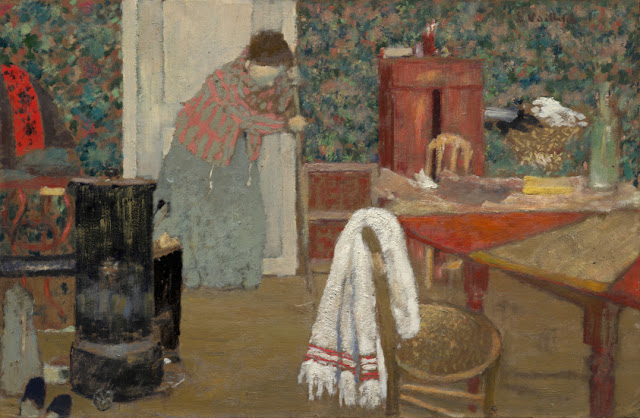

"Woman Sweeping"
Édouard Vuillard


A common thread through the Nabis was their ability to "draw emotion from the most modest acts of life", as Bonnard said.  Styles may differ, but the artists all portray everyday scenes around home--people at the dinner table, or patting their pets, or playing the piano. Routine tasks of housekeeping, or feeding and bathing children, occupy a central role. 


"The Lie"
Felix Vallotton, 1898

Some of these scenes are peaceful and serene.   Others have a certain tension that hints at conflict.  In fact, to illustrate the difference between these two emotions, the first room of the exhibit is titled "The Intimate Interior", and the next room is titled "The Troubled Interior".  As you might guess, the first room is filled with paintings that convey innocence, warmth and tenderness.  The next room holds works that convey drama, secrets, even betrayal.


"Washing the Baby"
Maurice Denis, 1899


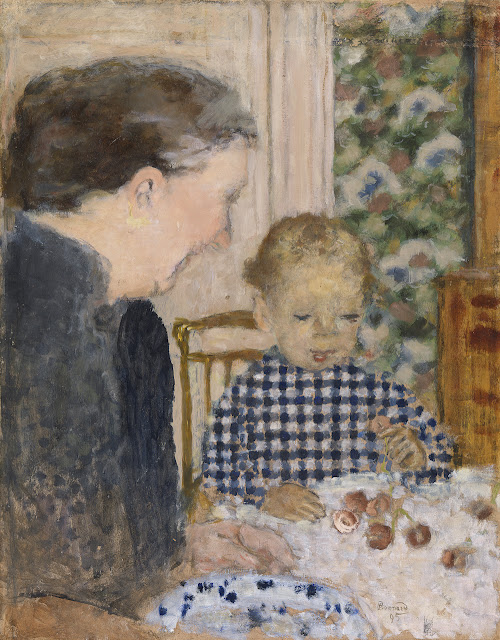
"Boy Eating Cherries"
Pierre Bonnard, 1895


Several writers have commented on the prominent role of wallpaper in these paintings.  I see this especially in Vuillard.  Some of his figures virtually disappear into the walls, as the patterns of their clothing blend with the patterns of the wallpaper.  It makes you wonder:  Are the figures emerging? or fading away?


"Mother and Sister of the Artist
Édouard Vuillard

Speaking of interior decor, I was fascinated by another sign that the Nabis still influence contemporary tastes.  The costume designer for the Netflix series "The Crown" says that her approach to the outfits for the Royal Family is inspired by the paintings of Vuillard.  She likes the way that Vuillard emphasized the patterns of clothing and decor. She also notes that the close, confined quarters of Vuillard's paintings are consistent with the Royals' lives, "locked in their palaces." The image below shows a scene from "The Crown" that she says is "a Vuillard painting, if ever there was one."


Scene from Netflix series "The Crown"


The Nabis exhibit completed its run at the Cleveland Museum this fall, and is open at the Portland (Oregon) Museum of Art through January 23, 2022.  Since I won't get to see the show, I might just splurge and buy the catalog, which gets great reviews.  There is also a good UTube video chat by the Portland curator of the exhibit, discussing some key works and curatorial themes of the show.  Enjoy!


Thursday, January 16, 2020

Why Bother?

Lesley with Diebenkorn
I recently visited The Phillips Collection in Washington, D.C. The impetus for my visit was the special exhibit "Bonnard to Vuillard: The Intimate Poetry of Everyday Life." And it did not disappoint! I broke one of my usual rules, and allowed myself to study the exhibition catalog in advance of my trip. Comparing my experience with the catalog to that of my in-person  visit, I was struck by the rewards I got from making the effort to go to the show in person. In today's world where almost everything can be done "virtually", why bother to go in person? Read on for my top three reasons.


Visiting the Nabis Exhibit


1.  You can't appreciate the scale of a painting from an image in a catalog. Paintings presented on the pages of a book are necessarily of somewhat the same dimensions. After all, a page is only so large! It would be far too distracting to show a person standing by each painting in order to show its relative size. We can read the actual dimensions in the descriptions of the paintings, but even knowing that information doesn't convey the "feel" that we get from confronting the painting in person. A small painting encourages you to step close, to peer in. A huge painting encourages you to step back, to let the whole of it wash over you. Just look at the dramatic difference is scale between the Diebenkorn painting at the top of this post, and the Nabis' paintings following it. Two different worlds!


"The Door and the Sewing Table"
Oil on Cardboard, 16.75 x 17.5 inches
Édouard Vuillard, c. 1900

2.  Reproductions don't show the true colors of the original. Even though we have wonderful new technologies for reproducing images, the reproduced image just cannot tell the real truth of the original. Oftentimes the reproduction comes very close to the original, but falls slightly short. Occasionally the reproduced image is so poor that it doesn't even seem like the same painting as the original. The catalog for the Nabi exhibition is a wonderful one, with excellent quality images overall. Even so, there are exceptions. For example, one of my favorite paintings in the exhibit was the one pictured immediately above. I swore to my husband that I had not seen it in the catalog--I was adamant that it was definitely NOT in the catalog. Upon returning home and consulting the catalog, I found that it was in fact pictured there. But the reproduction was so far off the mark that I didn't even recognize the painting. See the reproduction below (photo from the catalog). I rest my case.


Reproduction of Vuillard

3. A well curated exhibit places the paintings in a context that enhances your enjoyment and appreciation of the artwork. No question about this. I have attended exhibits that were so well staged that I felt as if I had entered a time machine and had been taken to the painter's world. The Anders Zorn retrospective in Paris is one that comes to mind, and I tell you why here. The Nabi exhibit at The Phillips was in that same category. Because the Nabis believed that art should be part of everyday life, they created not only paintings, but also decorative items such as stained glass, screens, tapestries, and vases. The Phillips included all of these types of objects. The curators went even further, and wallpapered some of the gallery spaces to reflect the style of the Nabis' era, and the nature of the interiors they painted.  I'm including an example below. The colors, the textures and the placement of the art evoked the decade of the Nabis at their zenith. A great job!


Gallery in the Nabis Exhibit, The Phillips Collection
If you can get to Washington for the Nabis exhibit at The Phillips, it's worth a journey. The show runs through January 26, 2020. If you've been, or if you go, let me know what you think!


Sunday, December 1, 2019

Going Public


"Passerby"
Oil on Cardboard, 7 7/8 x 11
Félix Vallatton, 1897

Whenever I visit a special exhibit at a museum, I always catch my breath to see a previously unexhibited painting that is on loan from a private collection. Such a rare treat! I marvel at the luxury it must be for those private collectors to live every day with paintings by Manet, or Bonnard, or Vuillard--right there in their dining rooms. 


"Yellow Gable"
Oil on Cardboard, 11 7/8 x 10 5/8 in.
Maurice Denis, c. 1895

Occasionally, through the great generosity of a collector, an entire collection comes into the public realm (rather than being parceled off and auctioned to private purchasers). One such occasion is being heralded now, at the Phillips Collection in Washington, D.C. The Nabis collection of Roger Sant and his late wife Vickie Sant has been pledged as a future gift to The Phillips Collection, and the works are now being shown in a special exhibit that runs through January 26, 2020. The exhibit is entitled "Bonnard to Vuillard: The Intimate Poetry of Everyday Life".


"Apprentices"
Oil on Cardboard, 12 x 9 in.
Édouard Vuillard, c. 1891-92

You don't have to have been reading this blog very long to know how much I love the Nabi painters, and especially Vuillard and Bonnard. The Nabis were a loosely organized group of avant-garde French painters working in the 1890's. They rebelled against the old-line, classical academies of art, as well as against the new-fangled Impressionists. 


"Street Scene"
Oil on Cardboard, 10 1/4 x 133/8 in.
Félix Vallotton, 1895

Although their styles were diverse, the Nabis were united by certain common factors. Their paintings tended to focus on scenes of domestic life, and they employed abstracted shapes of vibrant color. They often disregarded the rules of vanishing point perspective, so that their scenes were "flattened" into into an arrangement of color patterns. In fact, the words of one of the Nabis, Maurice Denis, became a sort of rallying cry for the group:


Remember that a painting--
before being a bottle horse, a nude woman,
or an anecdote of some sort--
is above all a flat surface
covered with colors
arranged in a certain order.

"Sleeping Woman"
Oil on Cardboard, 10 1/2 x 10 1/2 in.
Édouard Vuillard, 1892

The term "Nabi" is from the Hebrew word for prophet. Some say that these painters paved the way to what we know today as modern art. And yet their diversity and the quickly changing times led to an early disbandment. The Nabis held their final exhibit in 1900, and then went their separate ways, each going on to develop his own style and body of work. But the Phillips exhibit shows the group at its zenith.  I can't wait to see it.  If you can't make it to the exhibit, the book that accompanies the exhibit is excellent--well worth a look. We all owe a debt of gratitude to the Sant family for this transformative gift.

PS: It seems that the Nabis are having "a moment"--another Nabi, Félix Vallotton (some of whose works are pictured above), is the subject of a major current exhibition at the Metropolitan Museum in New York....


Sunday, January 28, 2018

Provence, Distilled


"Road above Bonnieux"
6 x 8, Oil on Paper
(c) Lesley Powell 2018
$195

With this post, I am excited to unveil a new series of paintings! I have been working on these for a number of weeks, and want to tell you a little bit about them. Faithful readers know that I love strong, straightforward shapes. I am also drawn to the beauty of simplification.  But as one of my posts is titled, "Simple isn't Easy". That's an understatement, for sure! It has taken a great deal of study, thought and work at the easel to bring these concepts to fruition in the new paintings.


"Provence, Distilled: Amber Waves of Grain"
5 x 10, Oil on Paper
(c) Lesley Powell 2018
$225
My mantra for this series comes from Maurice Denis, a founder of the Nabis. Denis wrote, "Remember that a picture -- before being a battle horse, a female nude, an anecdote or whatnot -- is essentially a flat surface covered with colors assembled in a certain order." In modern parlance, I would say "A painting is made of shapes of color". In the new series, I wanted to let the shapes speak out. I avoided too much modeling, or detailing of the objects.


"Provence, Distilled: Sunset Afterglow"
6 x 6, Oil on Paper
(c) Lesley Powell 2018
$150
The new series also springs from a concept that Felix Vallotton (another Nabi) used with great success. He called it the "paysage composé", or, loosely translated, the "put together landscape". Vallotton would make sketches of landscapes and take notes on location. Back home in the studio, he would put together paintings using various elements from different sketches.  He thus created landscapes that did not actually exist in nature, but represented something universal.  I have taken a page from Vallotton's book, freely moving trees or fields in some of my paintings in order to make a painting that hints at the universal aspects of the landscape. 


Paintings (c) Lesley Powell 2018

But my paintings are far from imaginary. They are all based on plein air paintings I have completed on location in Provence. I have used the colors seen with my own eyes on location, and put those colors into shapes that tell the gesture of the land. I have simplified a copse of trees into a simple dark block, a vineyard into a stripe of green. I call this "distilling" the elements of the landscape. Hence my title of the new series, "Provence, Distilled".  Despite the simplicity of these paintings--or maybe because of it--I hope that the viewer will feel a sense of distance and appreciate the sweeping character of the landscapes.


Paintings (c) Lesley Powell 2018

These are small paintings, on Arches oil paper--a beautiful, archival paper, specially made for oil paintings.  Most of them are priced between $150 and $195 (unframed). I think they make very handsome pairs or groupings, such as the ones above. I'm even including a photo (below) showing a frame treatment that would look fantastic. You can check out the full collection by clicking here--thanks for taking a look!   (PS: Flat rate shipping of $10 per painting).


Frame option (Artist Unknown)

Saturday, September 16, 2017

Edouard Vuillard, Revisited

While I am on holiday, I am re-posting a few favorites from years back. Enjoy!

"Lilacs"
Oil on cardboard, 14 x 11 1/8
Edouard Vuillard, 1892

Meet one of my favorite artists, Edouard Vuillard. I was first drawn to Vuillard's work because of his evocative paintings of interiors. As I learned more about him, I became fascinated by his early work as part of the "Nabis", a group

Tuesday, October 25, 2016

Finishing Touches

"Lady with an  Ermine"
Leonardo daVinci, c. 1489

I have written before about the painter's struggle to decide when to stop work on a painting. Many of us wrestle with the same question: "Is it the best it can be? Is it finished?". The answer is not always obvious. In fact, sometimes we think we have placed the final brushstrokes, but then we change our minds.
"Patina"
12 x 16, Oil on Linen
(c) Lesley Powell 2016
SOLD

For some artists, a painting is never finalized. At least not until it leaves the studio--and sometimes not even then (see below). As time passes, you have the opportunity to reflect on the painting. You may return to it after a few weeks with fresh eyes. Sometimes that fresh vision causes you to notice something that just begs to be adjusted. Then out come the brushes again! Just above you can see a painting that I THOUGHT was finished, until I 

Tuesday, May 26, 2015

That Touch of Red

"By the Sea, Honfleur"
Pastel on canvas, 45 x 37 cm
Eval Gonzales, 1881
I have often noticed how one small splotch of red in a painting can make all the difference. A dot of red can attract the viewer's eye, and direct the visual journey through the painting. It can draw attention to a focal point. In a painting that is otherwise composed of cool or subtle colors, that bit of red can serve as a counterpoint that makes the other colors come alive. Given my fascination with red, I was interested to come across an essay about the Impressionist painter Eva Gonzales, and her use of red. It was entitled "Expressive Red". **

The top painting is a wonderful example of using red in a carefully managed, restricted way. The painting is mostly cool blue/green colors. But the painter picked out a detail of the clothing, two thirds of the way up the height of the canvas, and used red as a "revealer". Voila! The red bow

Friday, February 27, 2015

Simple Shapes


"On the Beach"
Oil on cardboard, 42 x 48 cm
Felix Vallotton, 1899
This week I was thumbing through my catalogue from a retrospective of the works of Felix Vallotton. Vallotton (1865-1925) painted in France, and was a member of the "Nabis". I have written before about the Nabis and their approach to painting. There is something very powerful in the  simplicity of the Nabis' work. I find their use of simple, graphic patterns very appealing. I guess that's no surprise, since I am a fan of simplification in painting.


"Box Seats at the Theater, the Gentleman and the Lady"
Oil on canvas, 46 x 38 cm
Felix Vallotton, 1909
I don't know how Vallotton managed to say so much with so little. The painting directly above was the cover photo from the retrospective. A gloved hand, a face barely visible under a hat--a few simple lines tell it all. I can certainly see why the curators of the retrospective gave it the title "Felix Vallotton: The Fire Under the Ice"--the surface simplicity of these paintings belies their great impact.

Fellow painter Nancy Franke has written about her desire to simplify. She even wonders what "simplicity" means--whether it is brevity of brushstrokes, or use of a single idea, or even a simple background. I would say that Vallotton's paintings exemplify all of the above. 

Even more compelling in their simplicity are Vallotton's woodblock prints. Amazing! Here are a few of my favorites:


"L'Argent"
Felix Vallotton

"Le Violin"
Felix Vallotton, 1896
"L'Irreparable"
Felix Vallotton, 1898

These prints are irrepressibly modern in sensibility. And quite brave---look at those huge areas of uninterrupted black or white! In fact, the use of large areas of pure black and pure white are a signature of Vallotton's style, as are his bold cropping choices. (Before Vallotton, most printmakers used cross-hatching to vary the shading of their subjects from light to dark). 

There is definitely something to be learned from Vallotton about the benefit of using simple shapes. He also proves the power of a good arrangement of lights and darks. I think I'll be referring back to this catalogue often, to help me focus on simplification. Less is more!


Friday, May 23, 2014

Édouard Vuillard

"Lilacs"
Oil on cardboard, 14 x 11 1/8
Édouard Vuillard, 1892


Meet one of my favorite artists, Édouard Vuillard. I was first drawn to Vuillard's work because of his evocative paintings of interiors. As I learned more about him, I became fascinated by his early work as part of the "Nabis", a group of avant-garde French painters working in the 1890's. The Nabis rebelled against the old-line, classical academies of art, as well as against the new-fangled Impressionists. The term "Nabis" is from the Hebrew word for prophet. Indeed, these painters are said to have paved the way to what we know today as modern art.

Self Portrait
Eduard Vuillard, 1890
The rallying cry of the Nabis were the words of Maurice Denis. He said that a picture, more than representing a subject, "is essentially a flat surface covered with colors arranged in a certain order." The Nabis used color in purely instinctive ways, and were unconcerned with a literal representation of nature. Their work was abstracted and simplified. They often eliminated details, and flattened the subject matter. "Lilacs", at the top of this post, is a beautiful example of Vuillard's work as one of the Nabis. I also found the above self-portrait by Vuillard, which clearly reflects the Nabis sensibilities.

Self-Portrait
Édouard Vuillard, 1889

If you ever needed proof that an artist's style evolves over time, look no further than a second Vuillard self-portrait, immediately above. I am amazed that the same hand painted both of these pictures!

"Misa and Thadee"
Édouard Vuillard, 1897


Even more amazing is Vuilard's evolution from the Nabis days to his mature works. In fact, Stuart Preston notes that Vuillard never worked in the Nabis manner again, after he discovered his own true style. Preston might say that Vuilllard's own style was that of an "intimist"--a painter who undertook an intense exploration of the households of ordinary people. Preston calls this style a journey into the "mysterious poetic significance of everyday life and inanimate objects."

"Interior: Woman before a Window"
Oil on Panel, 24 3/4 x 22 3/4
Édouard Vuillard, 1900

I find Vuillard's interiors simply magical. His fascination with the decoration of the rooms is such that it often overwhelms or obscures the human figures. The rooms themselves seem to have a life of their own. I could not say it better than Andre Gide did. He said that Vuillard's work is art "speaking in a low tone, suitable for confidences". Intimate, indeed.