Showing posts with label art history. Show all posts

Sunday, April 5, 2026

Can You Say "Schjerfbeck"?

"Self-Portrait, 1912"
Oil on Canvas, 43.5 x 42 cm
Helene schjerfbeck, 1912


Though she is relatively unknown in the United States, I have admired the work of Helene Schjerfbeck for years.  Imagine my excitement when I learned that the Metropolitan Museum was mounting the first ever retrospective in the US devoted to her work. Cause for a trip to New York!  And the exhibit did not disappoint. It's one thing to look at reproductions in a book, but quite another to see the paintings in person. 


"Still-life in Green"
Oil on Canvas, 33.5 x 50 cm.
Helene Schjerfbeck, 1930

The difference is especially notable with a painter like Schjerfbeck, whose work involves a lot of textural manipulation.  Schjerfbeck chose different textures of canvas for different effects. She did a lot of back-and-forth work, putting down paint and then scraping it off.  The result is a painting that is "alive", and that shows the hand of the artist and the process of developing the painting.  In many cases (see above) the raw canvas is left showing through and is incorporated into the motif.

"Red Apples"
Oil on Canvas, 40.5 x 40.5 cm
Helene Schjerfbeck, 1915


Perhaps my favorite painting was the one just below, "Fragment".  As the wall copy at the Met notes, Schjerfbeck would have seen Renaissance frescoes in Italy a few years before making this painting, and the abraded surface calls to mind the deterioration of ancient frescoes wrought by time.  Besides the surface quality, I love the tenderness of this image, so vulnerable. In person, it practically glows.


"Fragment"
Oil on Canvas, 31.5 x 34 cm
Helene Schjerfbeck, 1904


It was a treat to see Schjerfbeck's minimalism, and elimination of details. She said so much with so little. Schjerfbeck wrote to a friend, "Let us avoid executing so precisely and exactly that our work closes the way instead of opening it. Let us IMPLY."  A woman after my own heart.

"At Home (Mother Sewing)"
Oil on Canvas, 86.5 x 62.3 cm
Helene Schjerfbeck, 1903

The exhibit at the Met closed on April 5, 2026, but you can still get the catalog on Amazon here.  Well worth a look!  I like the catalog from the Met exhibit, but even better (in my opinion) is the catalog from the Schjerfbeck exhibit at the Royal Academy of Arts in London in 2019.  It focuses more on an examination of her process, and it's available on Amazon also.  Happy reading!


Friday, February 27, 2026

Living Vuillard


If you've been reading the blog for a while, you know that I am a lover of Edouard Vuillard and the Nabis.  So you may not be surprised to learn that I had a gestalt "Vuillard moment" this week.


I was working on the needlework project pictured above, and as I bent over my yarn and needle, I felt just like a figure in a Vuillard painting.  Vuillard's mother was a seamstress (a corset maker, to be exact), and images of women sewing appear often in his work. In fact, I have studied some of his paintings by doing transcriptions of them (one shown below).  


"Woman in a Striped Dress", Edouard Vuillard, 1895


And then another connection dawned:  the needlepoint canvas I was working on was oddly reminiscent of the first Vuillard painting I ever saw, at the National Gallery in Washington, D.C., "Woman in a Striped Dress".  Do you see the connection??  I guess all roads lead to Vuillard.


And in current events, the Skarstedt Gallery in New York is mounting a Vuillard exhibit next month.  The focus will be on his early interiors--some of my favorites. I hope to see the exhibit and garner new inspiration.  Stay tuned!


Wednesday, January 28, 2026

Iconic Gardens

"Tuileries Icons"
12 x 16 inches, Oil on Cradled Panel
(c) Lesley Powell
(SOLD)

I'm illustrating this post with a new series of paintings inspired by the grand public gardens of Paris.  Two of my very favorite spots in Paris are the Luxembourg Gardens and the Tuileries Gardens. They have it all:  flowers, green lawns, sculptures, fountains, and wonderful people-watching.  Here are some fun facts about these gardens. 


"Together"
12 x 9 inches, Oil on Cradled Panel
(c) Lesley Powell

The Jardin des Tuileries take their name from tile making factories that once stood on that spot.  The French word for tile is "tuile".  "Tuileries" are workshops that made roof tiles, which occupied the area during the Middle Ages.  Catherine de Médici kept the name when she built her palace there in 1564--and so it carries on today.


"Two Pairs", 12 x 9 inches, (c) Lesley Powell


Both the Tuileries and Luxembourg Gardens have a symmetry  defined by broad walkways.  The walkways are not your ordinary sand or gravel.  Non!  They are made with a traditional French mixture called "stabilisé".  It's a combination of crushed gravel, sand and whitewash.  Stabilisé was developed in the 1600's by the great garden designer André Le Nôtre.  It is beautiful to look at, and has a pleasing crunch under foot, but boy can it be dusty. 


"Three's a Crowd"
12 x 16 inches, Oil on Cradled Panel
(c) Lesley Powell
(SOLD)

I especially love the green metal chairs that grace these gardens. The Sénat chairs are unique to the Luxembourg Gardens, and cannot be purchased by the public.  But a close interpretation was introduced in 2002, and is widely available.  It's made of aluminum, so is much lighter, and called the "Luxembourg" chair.  I wish I had a spot at home to put a few of these--a way to bring Paris home.  These paintings are another way.


"Adjoining", 9 x 12 inches, Oil on Linen Panel, (c) Lesley Powell


Final Fun Fact:  You can adopt a bench in the Tuileries--for a mere 5,000 euros!  Check it out here.

And to conclude:  One reason I love these places is that they are virtually unchanged from a hundred years ago.  Look at these paintings by John Singer Sargent and Felix Vallotton, and you will see the same features we enjoy today. The mounted urns and sculptures and balustrades have stood the test of time.  Enjoy!


John Singer Sargent, "In the Luxembourg Gardens", 1879

Felix Vallatton, 1895


Tuesday, June 3, 2025

In Hopper's Footsteps


"Stairway at 48 rue de Lille, Paris, 1906"
Edward Hopper


 Years ago, I was captivated by an exhibit at the Mint Museum in Charlotte, "Hopper in Paris".  We think of Hopper as a quintessentially American painter, but he spent a significant amount of time in Paris between 1906 and 1910.  And that time yielded over one hundred drawings and paintings.  During his early Parisian stays, Hopper lived at 48 rue de Lille, in the 7th arrondissement.  His quarters adjoined the Evangelical Baptist Church (which had sponsored his visit).  Here's what it looks like now:


And guess what?  I was there last month!  The ground floor is now a space dedicated to art exhibits, and my friend Marie Sand had an opening there to which I was invited.  Imagine my excitement when she showed me the courtyard--the very one that Hopper had painted. Here's the courtyard as painted by Hopper, and how it appears now:


I poked around the building a little bit, and discovered some humble stairways that were very reminiscent of the one Hopper painted (top image).  Perhaps not the very stairs that were the subject of Hopper's painting, but close enough to give me goosebumps.  It's a thrill to stand in the footsteps of a great painter from the past, and to get a glimpse into his life and his painting process.  I learned from standing in Hopper's shoes that the most humble places can be the impetus for memorable paintings.   


I'm closing with another Hopper painting of his courtyard at rue de Lille, from a higher vantage point.  I can see in these early paintings the themes that would come to define Hopper:  interior spaces without human activity, and the architecture of simple planes and lines.  Hopper's Paris works are definitely worth a close study. 


Wednesday, March 22, 2023

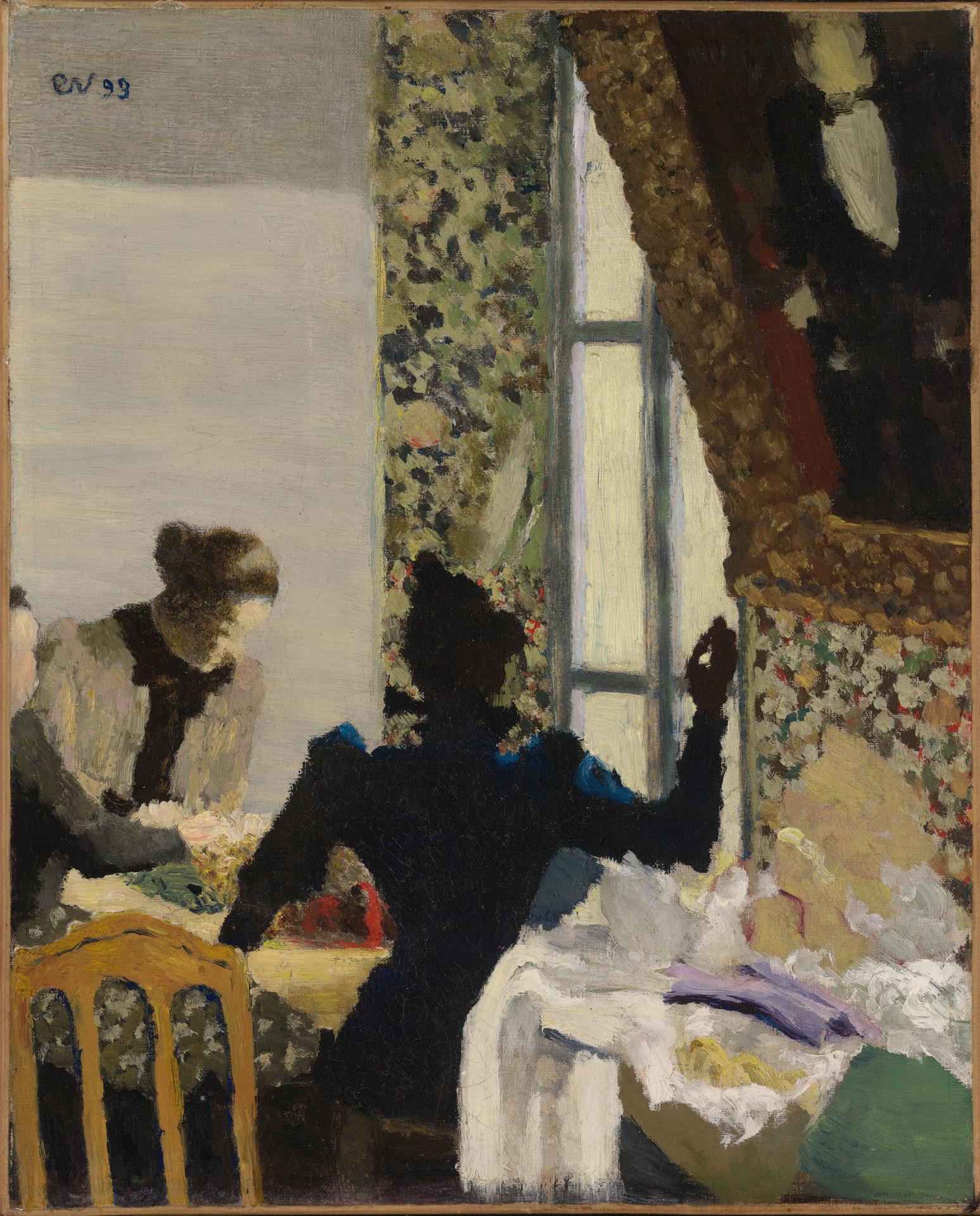
Vuillard and the Silhouette

"Interior with Women Sewing"
Oil on Canvas, 15 7/8 x 12 11/16 inches
Édouard Vuillard, 1893 


Faithful readers know that Édouard Vuillard is one of my favorite painters, and one who greatly inspires me.  I've been revisiting some of his work, and exploring his use of the silhouette.  Truly masterful!  


The top image is variously called "Interior with Women Sewing" or "L'Aiguilée" ("The Needle").  Oh, wow, I can just feel that hand with the needle pulling the thread taut.  The central figure has such a strong gesture.  There are actually three women in this painting, but the silhouettes of the ones on the left serve merely to bring you eye to the main actor in the center.  It's a masterpiece of composition and sparing use of shapes.


"Beneath the Lamp"
Oil on Canvas, 12 1/2 x 15 3/4 inches
Édouard Vuillard, 1892

The next one is also full of lessons for us lesser mortals.  There is a lot of "busy-ness" in the interior decor, but the power of the two female silhouettes create unity and harmony.  There are a lot of lost edges, where the women's silhouettes fade right into the darkness of the room.  As a result, only partial silhouettes remain.  And even then, they are so powerful!  I also think the silhouettes of the chairs are wonderful compositional tools.  They define the area of interest, and bring our eye in a circle. 


"Seamstress"
Oil on Panel, 9 1/4 x 13 1/2 inches
Édouard Vuillard, 1892-95


And the silhouette doesn't need to be blackened.  This last painting shows how a simple, un-modeled figure in silhouette can anchor a painting.  Again, the interior space is replete with details and small shapes of color.  Almost dizzying to the eye.  But the solid form of the central figure holds everything together.  Such a beautiful piece of magic.

If you are interested in more about silhouettes, and especially Vuillard's, check out this post from a few years ago.  Happy reading! 


Saturday, December 24, 2022

Giotto's Frescoes


What could be better, on Christmas Eve, than to visit the nativity scenes from a masterpiece of Western art--the Scrovegni Chapel in Padua, Italy. Just to enter the little chapel and see the view pictured above takes your breath away. The frescoes that cover every surface of the Chapel were painted by Giotto de Bondone (a.k.a. "Giotto"). They were done over 700 years ago--and they are as beautiful today as when they were first created. 


The Annunciation

Giotto's fresco cycle tells the story of God's promises and the life of Jesus. The nativity portions of the frescoes start with the Annunciation (above). They show the Angel Gabriel coming to Mary with the message that she would bear the Son of God. To quote from Madeleine L'Engle's book, "What an amazing, what an impossible message...!   Possible things are easy to believe. The Glorious Impossibles are what bring joy to our hearts, hope to our lives, songs to our lips."


The Visitation

Next we see Mary go to visit her cousin Elizabeth. Elizabeth was also with child, and her unborn child recognized the baby Mary was carrying, and leaped for joy. Another Glorious Impossible event! 


Nativity (above), and Detail (below)

Jesus was born in a stable in Bethlehem. Nearby, shepherds with their flocks were visited by an angel, telling them of the birth. I love Giotto's depiction of this story in the fresco above, showing the host of heavenly angels, singing to the glory of God. And I can't resist mentioning how Giotto took a huge leap forward in the history of art by depicting these figures in such a natural, human way. No more stylized figures. Here we see very human gestures and expressions. The great art critic John Ruskin said that Giotto painted "the Madonna, Saint Joseph and the Christ, yes, by all means...but essentially Mama, Papa and Baby."  


The Adoration of the Magi (above), and Details (below)

Now we come to the Adoration of the Magi. What a gorgeous fresco, and how full of life! Madeleine L'Engle writes that the Magi (or wise men) were serious scholars who studied the heavens and movements of heavenly bodies. Each came to Judea at the time of Jesus' birth because of what he had read in the movement of the planets and stars. It is very fitting that this fresco shows a comet streaming through the heavens. The wise men believed that something happening in Bethlehem would change the world, and they brought gifts of gold, frankincense and myrrh.


Above many of these frescoes we see the stars in their courses. Echoing the individual frescoes, the ceiling of the Chapel shows a vast expanse of sky, punctuated by beautiful stars. Their brilliance shines above all, and reminds me of the majesty of creation. Stirring thoughts during this advent season!

Monday, May 30, 2022

Whetting my Appetite

"Ménerbes"
Nicolas de Staël


After missing the last two summers in Provence, I am now preparing to return. I have cancelled so many trips since COVID--I'll believe it if and when I actually arrive!  One thing I am really looking forward to is the opportunity to explore  the village of Ménerbes in more depth.  I'm not interested in the Méberbes of Peter Mayle (author of the bestseller "A Year in Provence"). My attraction is to the Ménerbes of Nicolas de Staël.  And the Ménerbes of Dora Maar, a romantic partner of Picasso and subject of many of his paintings, who was an artist in her own right.


"Agrigente"
Oil on Canvas, 60 x 81 cm
Nicolas de Staël, 1953-54
Painted in Ménerbes

De Staël lived in Ménerbes in the mid 1950's, and produced some magnificent work there.  I have written all about that period of his paintings earlier, so I won't repeat myself.  These are my favorites among all of de Staël's paintings--such brevity, such color, such strength, nothing wasted!  The top image is his painting of Ménerbes itself.  


The house de Staël bought and lived in in Ménerbes still stands (photo above).  In fact, the house was home to the British food guru Elizabeth David, before de Staél.  (It starts to seem that all roads lead to Ménerbes...). How I wish there were an opportunity to go inside.


"Portrait of Dora Maar"
Pablo Picasso

Happily, that opportunity does exist for the house where Dora Maar lived.  Dora Maar bought the house in 1944 after breaking up with Picasso.  She spent every summer there, painting in the isolation of the small rural village.  After her death, an American patron of the arts, Nancy Brown Negley, bought the house and renovated it.  It now hosts residencies for artists and writers. And you can book an in person tour!  


Portrait of Pablo Picasso
Dora Maar, 1936

This summer La Maison Dora Maar is mounting an exhibit with works by Nicolas de Staël, Dora Maar, and others who painted in Ménerbes in the 20th century.  Can't wait to check it out!  


Saturday, April 30, 2022

Studios Around the World


Table in Cezanne's studio, Aix-en-Provence

Paul Cezanne, Still Life with Fruit Dish

Faithful readers know that I am fascinated by painters' studios. I suspect that even non-painters share this fascination.  It's especially intriguing to visit "preserved" studios of some of the greats from decades (or centuries!) past. If you know an artist's body of work, seeing his or her studio brings a shock of the familiar. What art lover could possibly visit the studio of Cezanne in Aix-en-Provence (seen above), and not recognize  objects from his wonderful still lifes? 


I'm not the only one fascinated by studios and props.  The photographer Joel Meyerowitz has published an entire book dedicated to close ups of the objects in Cezanne's studio.  And that's not all--he also has a book featuring the objects in Giorgio Morandi's studio in Bologna.  Some day I am going to Bologna  to see the studio in person!


Paul Cezanne, "Still Life with Plaster Cupid"


Not that anybody's going to be writing a book about me anytime soon--but I have my own cherished collection of studio props.  The wonky silver-plate teapot from a Maine flea market, the bulbous vase that's shaped a lot like one Morandi had, and of course a full complement of blue and white Chinese export ginger jars (some authentic, some fake).  It's fun to get to know them all, as I observe them very carefully during painting.


Lesley's Objects


I'm closing with a list of artists' studios I have enjoyed visiting, and some that are on my wish list.  If you share the fascination, check them out below. Even those that are reconstructed (noted below) are very evocative.  Each name below is linked to more detailed info, if you care to click on it. Happy touring!


PARIS:  Alberto Giacometti (reconstruction)


                        Antoine Bourdelle  (original)


                        Jean-Jacques Henner (reconstruction)


BOLOGNA: Giorgio Morandi (original)


MADRID:  Joaquin Sorolla (original)


AMSTERDAM:  Rembrandt (virtual tour here) (reconstruction of interior, in original sturcture)


Thursday, March 24, 2022

Fra Angelico Reimagined

Detail from "Nolo Me Tangere", Fra Angelico


Among the many wonderful Italian painters of the early Renaissance, Fra Angelico is one of my favorites.  Though he painted his share of gilded, regal looking saints and angels, Fra Angelico's work also speaks of a more humble outlook. Even the smallest of nature's flora and fauna in his work are lovingly painted.  And the humanity of his figures is striking.


Fra Angelico, Perugia altarpiece predella

The influence of Fra Angelico echoes down the centuries, and reaches serious painters even today.  One thing that captivates me is the depth and volume of his work.  I am intrigued by the "cross sections" of structures, in which we look through arches and doorways to the happenings within.  This use of architecture is an important element in the workings of his paintings. 


"The Annunciation"
Fra Angelico, c. 1426

We can learn many lessons from Fra Angelico. I'm showing here how two different artists have interpreted some of his work recently.  I love how the painter Chris Liberti has interpreted "The Annunciation".  Liberti used the architecture of Fra Angelico's original work (above), yet adapted it as a framework for a contemporary vision. Liberti's interpretation (below) is a visual feast--completely his own, and at the same time completely comprehensive of the original.  I love the way Liberti's shapes and colors are so ephemeral, and so intertwined.  His painting is simply full of wonder.


"Fra Backyard"
20 x 20, Oil on Wood
(c) Chris Liberti, 2020

I am also taken with a recent collage by Olivia Hiester, based on another work of Fra Angelico.  With perfectly chosen shapes of color, Hiester evokes all the emotion and movement of the original painting. In fact, I think that the collage's simplification enhances, rather than detracts, from the power of the original. Hiester's cutouts recreate the fabrics' drape and fold to convey perfectly the volume and dimension of the figures. There is a solidity here that feels very earthly, despite the heavenly halos.  Olivia's work and the original fresco are below. Both lovely.


Painter Paper Collage, (c) Olivia Hiester 2022

I have read that the great artist Mark Rothko was especially impressed by Fra Angelico's frescoes at the Convent of San Marco in Florence, Italy.  Rothko was so taken by the "inner light" of the frescoes that he is said to have developed a special chalk mixture that he could use on canvas, in order to achieve a similar luminosity. I conclude with Rothko's painting, said to spring from this experience.  Long live Fra Angelico!  


"Untitled, 1950", Mark Rothko