Showing posts with label Henri Matisse. Show all posts

Thursday, February 17, 2022

Matisse, from Moscow


On my recent trip to Paris (pre-Omicron), I visited the Louis Vuitton Foundation, to see the blockbuster exhibit "The Morozov Collection: Icons of Modern Art".  Most private collections I have seen in museums are smallish, intimate, and narrowly focused.  Not this one! The Morozov brothers were textile magnates in pre-Revolutionary Russia.  Starting in 1903, they amassed a collection of French and Russian art that would constitute a museum in itself. Reuniting these works (which were dispersed to state museums following the Bolshevik Revolution) makes for a sprawling, staggering, mind-blowing show that can truly be called "historic".
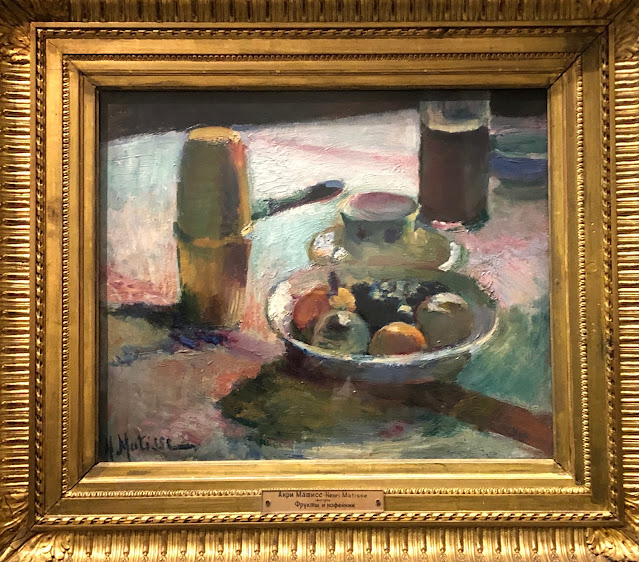

"Fruit and Coffeepot"
Oil on Canvas
Henri Matisse, 1901

Much has been written about the exhibit, so I don't want to repeat a bunch of superlatives.  Instead, I am writing about just one of the many things that struck me:  the range of Henri Matisse.  Midway through the exhibit I saw a beautiful still life whose creator I could not identify.  As I admired the work and lingered with it, I saw that it was a painting by Matisse.  So unlike the Fauvist work he is commonly known for.  


"The Bottle of Schiedam"
Oil on Canvas
Henri Matisse, 1896

Next to it hung another quiet still life, dark in palette, almost reminiscent of Chardin. Surprise, it was another Matisse.  I don't know how I have missed these early works before now. 


"The Casbah Gate"
Henri Matisse, 1912-1913


Fast forward a decade or so from these early works, and the exhibit included masterpieces from Matisse's travels in Morocco.    Again, much has been written about Matisse's time in Morocco as a turning point in his work. The dramatic evolution in his painting could not be clearer.  And surely it reflects what was going on in the art world at the time.  Modernism was blowing off old traditions, and forging a new way of seeing and painting. 


"View from the Window, Tangier"
Henri Matisse, 1912-13


I was drawn to Matisse's Moroccan triptych, two parts of which are pictured above.  In the second painting, I especially loved the way his blue shadow swallowed all the details in its path.  Ostensibly about the light and shadow of Tangier, to me this painting is all about the symphony of the blues.  Their coolness  makes the warmth of the light shine all the more.


"Bouquet"
Oil on Canvas
Henri Matisse, 1907


One wonders whether this exhibit could have been brought off today, given the diplomatic issues involved, and the requirement that Putin personally endorse certain elements.  Such a thought adds to the "once in a lifetime" aspect of the show.  If you have a chance--the show has been extended to April 3, 2022.  If you can't go to Paris, you can book a virtual tour of the Morozov Collection show online here.  FYI, I thought the reproductions in the catalog were not good, but the online viewing is excellent. 


PS as of  March 4, 2022:  With the outbreak of war, I have read this:

Blockbuster Show of Russian Collection Is Still in Paris – A landmark exhibition of the collection of Russian brothers Mikhail and Ivan Morozov remains on loan at the Louis Vuitton Foundation in France until April 3. The show required a colossal diplomatic effort, including Putin’s personal sign off on the loans. But in light of Russia’s invasion of Ukraine, some are asking whether the French state can and should seize the collection, which includes treasures by Van Gogh, Gauguin, Monet, and Picasso. It is one of the most valuable modern art collections in the world, and hadn’t left Russia since the turn of the 20th century. (Artfix Daily, Le Figaro)

But LUXUS reports:

“According to the law in force since August 10, 1994, the French state cannot sequester these paintings, pastels and sculptures because they belong to foreign public institutions,” explains lawyer Olivier de Baecque, a specialist in art law. In addition, a decree of unseizability was taken on February 19, 2021 by the Minister of Europe and Foreign Affairs and the Minister of Culture concerning the arrival of works in France. “Before each exhibition, it is sufficient to promulgate an order of unseizability, and to extend the device in case of prolongation of the event. ”


Wednesday, October 14, 2020

What the Fauves Knew

"Woman with a Hat"
Henri Matisse, 1905

"Fauve" means "wild beast" in French--and that's exactly what the Fauve painters were!  The so-called Fauves painted in France in the early years of the 20th century.  Their paintings featured bizarre, vivid colors. They used flat areas of pure color, in hues that often bore no resemblance to reality.  But despite their unnatural colors, the paintings were still discernable representations of their subjects.


How did the Fauves accomplish that? They knew an important proposition about color: If the value is accurate, the hue doesn't matter.  That's right.  Every color has a certain value (relative darkness or lightness), as well as a certain hue (color on the spectrum). Just check the photo immediately above, in which I have converted Matisse's vividly colored painting into black and white. Pretty convincing, no?  


"Teapot and Sugar Bowl"
(c) Lesley Powell 2020

I recently conducted my own experiment with this proposition. I used a still life setup, and painted it with bold, unrealistic colors, paying VERY careful attention to the value of each color. And sure enough, the black and white image is proof of concept.


But let's not get too analytical. We should just enjoy the zestful use of color that characterized the Fauves. Sometimes a joyful romp in pure color can be a real mood lifter.  And since we can all use a lift in spirits about now, I'm closing with more images for your viewing pleasure. You may be well acquainted with Matisse, but his lesser known Fauvist compatriot André Derain was also a master of color. Thought you'd enjoy seeing a couple of his paintings.  'Til next time!


"Charing Cross Bridge"
André Derain, c. 1906

"Landscape near Chatou"
André Derain, 1904


Sunday, February 16, 2020

Blue & White Forever!


"Anemones and Chinese Vase"
Oil on canvas, 23 5/8 x 36 1/4
Henri Matisse, 1922
Among the small handful of things that I would count as truly timeless, one rises to the top: blue and white porcelain. The Chinese invented porcelain as long ago as the 700's, but they managed to keep the formula secret for over a thousand years. Europeans probably saw their first porcelain when Marco Polo brought some back to Venice after visiting Kublai Kahn. And the fascination began! Blue and white porcelain has always had a hint of the exotic, and has been widely sought after. No wonder that artists have portrayed it in their still life paintings ever since the Renaissance.

"Still Life with Chinese Porcelain Jar"
Willem Kalf, 1669
I love to look at paintings of blue and white porcelain, and consider the vastly different approaches to painting it. From the finely detailed works of Dutch masters, to more whimsical depictions by Matisse and other moderns, there much to delight the eye. And of course the scholarship on blue and white porcelain is limitless. I have read that the vase depicted by Matisse in the top image is "underglaze blue with figures in a landscape, possibly of the Kanji period" (that's 1622-1722).*  How it can be identified so precisely is something of a mystery to me. But it's nice to look at, and it's the first place my eye goes in this painting.

"Lady at the Tea Table"
Oil on Canvas, 29 x 24
Mary Cassatt, 1883-85
Sometimes porcelain is the main player in these paintings, and other times it is a supporting actor. Just above is an example of blue and white as a strong supporting actor: a portrait by Mary Cassatt, depicting her cousin serving tea. The tea set is of Nanking Ware, probably from the late 1700's. They say that it was probably a cherished family heirloom. Very appropriate for inclusion in a family portrait, wouldn't you say?

"Still Life with Melon"
Oil on Canvas, 20 7/8 x 28 3/4
Claude Monet, 1872
Nowadays blue and white wares are widely reproduced. Some reproductions look cheap, but others can be very convincing. I have both types in my studio to use as props. And one or two true antique pieces. There's no substitute for the real thing! The coloration of the antique pieces is truly inimitable--and fun to paint. 

"Chinese Pots"
Oil on Canvas, 11 x 14
(c) Erin Gafill

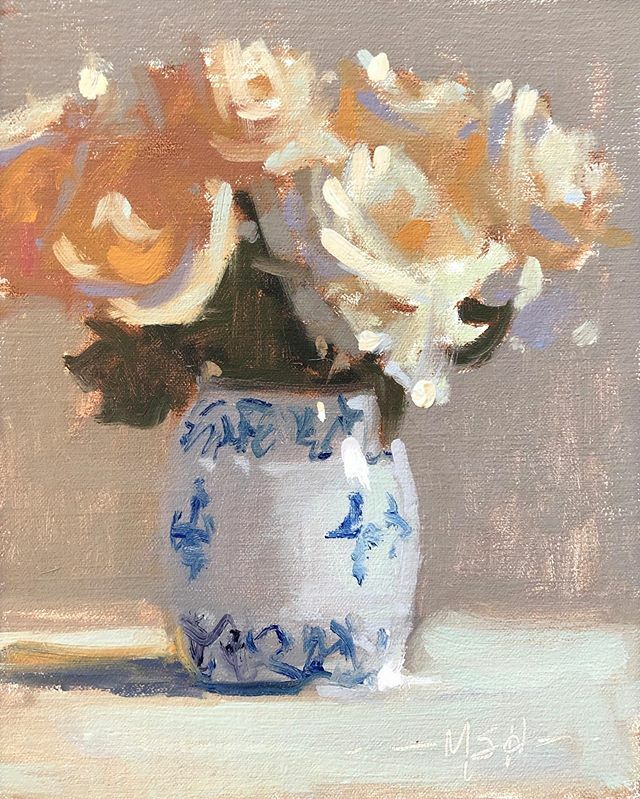
I'm closing with paintings by some of my favorite contemporary still life painters, and one of my own. Enjoy!


"Silvery Light"
Oil on Linen Board, 10 x 8
(c) Marjorie Hicks

"Orchids, In Full Swing"
Oil on Board, 24 x 18
(c) Lesley Powell, 2019
Available at Huff Harrington Fine Art


*Identification of particular porcelain depicted in paintings is from Blue & White China Origins and Western Influences, ed. John Esten, c. 1987.

Wednesday, May 16, 2018

At Home with Art

"Nympheas en fleur"
Claude Monet, 1915
In case you haven't heard, Christie's auction of David Rockefeller's magnificent art collection just broke all records as the biggest single-owner sale ever held at auction.  On May 8, 2018, a collection of forty four sculptures and paintings from the 19th and 20th centuries went for a whopping $646 Million (and the entire proceeds will go to charity).  And this was just the first group to be auctioned! The Monet waterlillies pictured above triggered a fourteen minute bidding war, and brought $84.7 Million. The winner was a telephone bidder--I can't stop wondering who it was.


Monet and Juan Gris in hallway at Hudson Pines

But more intriguing to me than the auction prices is the thought of these masterpieces hanging in the Rockefeller's homes over the years. The waterlillies hung over the staircase at Hudson Pines, the Rockefeller home in Westchester County, NY. Can you imagine walking by this painting every day on your way up and down the stairs??!


Picasso's "Young Girl with a Flower Basket", 1905
Photo courtesy of Christie's

Another masterpiece, Picasso's "Young Girl with a Flower Basket", used to hang in David Rockefeller's library, in his Manhattan townhouse. This one has a fascinating history. It was in the collection of Alice B. Toklas and Gertrude Stein--major figures in avant-garde Paris of the early 20th century--who often hosted the likes of Hemingway, Matisse and Picasso in their home. When the collection became available

Tuesday, May 9, 2017

Under the Influence


"Under the Influence"-- I'm not talking about alcohol, but rather the sway of another person. We are all subject to various influences, and lately the idea of how one artist influences another has been at the front of my mind. My thoughts were first stimulated by seeing the wonderful Matisse/Diebenkorn exhibit at the San Francisco Museum of Modern Art. The entire show is an exploration of the influence that Matisse had on Diebenkorn--even though they never met! 


Left: Diebenkorn; Right, Matisse

The catalog for this show included an essay about "influences" in the world of art. I especially loved the words from the great poet T.S. Eliot: "A poet cannot help being influenced, therefore he should subject himself to as many influences a spossible, in order to escape from any one influence." I love this idea. It is too easy, especially for a visual

Sunday, January 29, 2017

They Meet at Last!

Photo: Mitro Hood, Baltimore Museum of Art

Some months ago, I wrote with great anticipation about the upcoming Matisse/Diebenkorn exhibit. The reviews are in, and they are glowing! The exhibition has just finished its run at the Baltimore Museum of Art, and will open March 11 at the San Francisco Museum of Modern Art. 


Left, Matisse; Right, Diebenkorn

Reviews call the exhibition "deeply stirring", "important", "radiant", "glorious".  It pairs paintings by Diebenkorn with relevant works from all periods of Matisse's life. Diebenkorn was in his 20's when he first discovered Matisse, and was deeply impacted by the work of the French master. Throughout his entire career, Diebenkorn sought out works by Matisse, collected books on Matisse, and stuffed sketchbooks with clippings and postcard reproductions of Matisse's works. The current exhibit has been called a celebration of the influence of Matisse on Diebenkorn.


Left: Diebenkorn, Untitled (Ocean Park), 1971
Right: Matisse, View of Notre Dame, 1914

I have read that the pairings of the two artists' works are "not too literal", but illustrate the deep connection between the two painters. As Sebastian Smee wrote for the Boston Globe, "When you love an artist...your feeling for what he wanted to do, and for the temperament and the thinking behind those ambitions, becomes so engaged that everything he or she attempted interests and involves you. Richard Diebenkorn had that feeling for Henri Matisse." Amen.


Diebenkorn, "Recollections of a Visit to Leningrad", 1965

Luckily for me, I plan to visit friends in California this spring, and that means I may have an opportunity to see the exhibit in San Francisco. Can't wait!  Meanwhile, for Diebenkorn fans, check out the newly released catalog raisonne' from Yale University Press that covers all works throughout his entire career, and gets great marks as a "monumental work" done with "meticulous care".  Oh, and by the way, the book review for these volumes is headlined "The Heir to Matisse...". 


Thursday, June 16, 2016

Diebenkorn/Matisse

Left: Diebenkorn, Untitled (Ocean Park), 1971
Right: Matisse, View of Notre Dame, 1914

Great news! While researching Richard Deibenkorn for a recent post, I learned that there will be a major exhibit coming soon to both coasts of the US. It will show works of Diebenkorn alongside those of  the great French painter Henri Matisse. Much has been written about the influence of Matisse on Diebenkorn. It will be so exciting to see their work hanging together, and to look for the connections and inspirations running between them!


"Studio: Quai St. Michel"
Henri Matisse, 1916

Diebenkorn first encountered the work of Matisse in the early 1940's, when he was in the military. While stationed at Quantico, Diebenkorn visited the Philips Collection in Washington, D.C., where he saw Maitisse's "Studio, Quai St. Michel" (above). Diebenkorn later said that he was quite stuck by this painting, especially by the sense of space it created. He was also intrigued by the problem of representing both interior and exterior light in the same painting. This inside/outside approach was something that Diebenkorn would return to time and time again. Here's one example:


"Interior with Doorway"
70 3/8 x 59 1/2, Oil on Canvas
Richard Diebenkorn, 1962

Diebenkorn studied Matisse throughout his career. I have read that seeing Matisse's  "French Window at Collioure" (below) must have been an epiphany for Diebenkorn. They say that that this Matisse painting was a touchstone for for Diebenkorn's wonderful and extensive series of Ocean Park paintings.  


"French Window at Collioure"
Henri Matisse, 1914

"Ocean Park #79"
Oil on Canvas
Richard Diebenkorn, 1975

The curators of this new exhibit had access to Diebenkorn's own collection of books on Matisse--wouldn't you love to see and touch those? I wonder if he scribbled notes in them, or made sketches. Maybe I will find out, because I really hope to see this exhibit. Mark your calendars: it will be at the Baltimore Museum of Art from October 23, 2016 to January 29, 2017, and at the San Francisco Museum of Modern Art from March 11, 2017 to May 29, 2017.

Monday, January 4, 2016

Everything's Coming up Roses...

"Heirloom Roses"
16 x 20, Oil on Canvas
(c) Lesley Powell 2016

Available
As you may have noticed, I very rarely paint flowers. And yet I have started the New Year with a whole series of roses. I don't know how it happened--it took me by surprise! I experienced the thrill of discovery, painting something for the first time.


"Three Stems"
8 x 8, Oil on Board
(c) Lesley Powell 2016

SOLD
Henri Matisse said that "There is nothing more difficult for a truly creative painter than to paint a rose, because before he can do so,

Wednesday, April 29, 2015

Flower Power

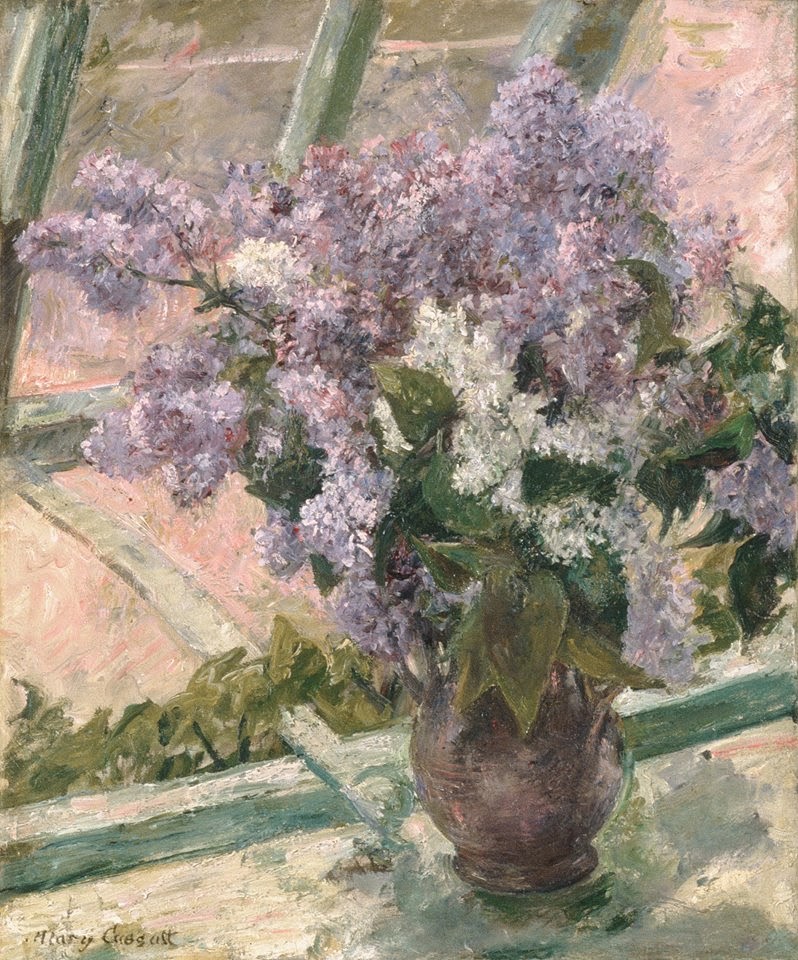
"Lilacs in a Window"
Mary Cassatt, 1879
Up now at the Virginia Museum of Fine Arts in Richmond: "Van Gogh, Manet,and Matisse: The Art of the Flower". I recently saw the exhibit, and was impressed with its breadth. There were masterworks from museums such as the Louvre and the Musee d'Orsay in Paris and the Van Gogh Museum in Amsterdam. It's definitely worth a detour to catch this one. One might ask, "How many pictures of flowers can a person look at in one show??". No problem for me--the subject matter is not so important, because